Published 3 November 2026
Stairwell notice board: what a Swedish BRF must post
Under Swedish law, two documents must be posted on the stairwell notice board of an apartment building owned by a housing cooperative (bostadsrättsförening, BRF): the certificate from the latest mandatory ventilation inspection (OVK) and the energy performance certificate. The requirements come from the Planning and Building Ordinance and the Act on Energy Performance Certificates for Buildings. Everything else on the board, such as meeting notices, contact details and fault reporting, is decided by the cooperative's statutes and its board. Documents that only the board and other authorised people should see belong in the cooperative's binder, and that binder can sit behind a QR code at the entrance.
This article is written for board members of Swedish housing cooperatives and for property managers. It covers what the law requires on the board, what is usually posted for practical reasons, what belongs in the binder, and how a QR code at the entrance can hold it together. The legal sources are Swedish and are linked in Swedish.
What the law requires on the stairwell notice board
The OVK certificate
Under Chapter 5, Section 1 of the Planning and Building Ordinance (2011:338), a building's owner must have the ventilation system inspected before it is first used and then at regular intervals. In a housing cooperative, the cooperative is the owner. Under Chapter 5, Section 5, the inspector gives the protocol to the owner and issues a certificate stating the date of the inspection, the result and the date of the next inspection. Under Chapter 5, Section 6, the owner must post the certificate in a clearly visible place in the building.
The intervals are set in Section 3 of Boverket's regulations on ventilation inspections (BFS 2011:16, consolidated): every three years for apartment buildings with FT or FTX ventilation (fan-driven exhaust and supply air, with or without heat recovery), and every six years for apartment buildings with F, FX or S ventilation (exhaust only, exhaust with heat recovery, or natural ventilation).
The energy performance certificate
A building where apartments are held under tenant-ownership counts as let under a right of use (nyttjanderätt). Under Section 5 of the Act (2006:985) on Energy Performance Certificates for Buildings, the owner must then make sure a certificate always exists, and under Section 13 it must be displayed in a clearly visible place in the building. Boverket, the Swedish National Board of Housing, Building and Planning, states that the cooperative is responsible because it owns the building, that a summary of the certificate should be posted, and that the entrance is often a natural place for it. A certificate is valid for ten years.
When an apartment is sold, the cooperative is responsible for a valid certificate existing. The seller is responsible for stating the energy class in the advertisement and for showing the certificate to prospective buyers and handing it over to the buyer.
What is usually posted for practical reasons
No law governs the rest of the board, but several items are tied to legal requirements or to the statutes.
- Notice of the general meeting. Housing cooperatives follow the rules on general meetings in Chapter 6 of the Economic Associations Act (2018:672), with the exceptions in Chapter 9, Section 14 of the Tenant-Ownership Act. Members must be called in the way the statutes specify (Chapter 6, Section 21), and the notice of an ordinary meeting must be issued no earlier than six weeks and no later than four weeks before the meeting (Chapter 6, Section 17). The statutes may move the later limit to two weeks. If the statutes name the stairwell notice board as a channel, the notice must be posted there.
- Contact details for the board and the property manager, and how to report a fault.
- Fire safety. Under Chapter 2, Section 2 of the Civil Protection Act (2003:778), owners and holders of a right of use must, to a reasonable extent, keep equipment for extinguishing fires and saving lives, and take the measures needed to prevent fire. The act does not require anything to be posted, but a short instruction on what to do in a fire is a common way to reach residents.
- Times and routines: laundry room, waste collection, cleaning days and planned work in the building.
| On the board | Requirement | Source |
|---|---|---|
| OVK certificate | Must be posted in a clearly visible place in the building | Ordinance 2011:338, Ch. 5, Sec. 6 |
| Energy performance certificate | Must be displayed in a clearly visible place in the building | Act 2006:985, Sec. 13 |
| Notice of general meeting | As the statutes specify, within the statutory time limits | Act 2018:672, Ch. 6, Secs. 17 and 21 |
| Fire information | No posting requirement; the owner must prevent fire | Act 2003:778, Ch. 2, Sec. 2 |
| Contact and fault reporting | No legal requirement | Board decision |
What belongs in the cooperative's binder
Much of what a board needs should not hang on a board that everyone in the stairwell can read: minutes, contracts, annual reports, the maintenance plan, drawings and the full inspection protocols. The OVK certificate goes on the wall, but the protocol with measurements and remarks stays with the cooperative.
If the building has a lift, it must be inspected at the intervals Boverket sets, between six months and six years (Ordinance 2011:338, Ch. 5, Sec. 8). The lift may not be used if the person responsible for it cannot show a protocol proving it meets the requirements (Sec. 14), or if a required inspection has not been made on time (Sec. 13). The protocols need to be easy to find.
A paper binder, or a folder kept by one board member, changes hands at every change of board. Questions such as when the latest OVK was done, who signs for the cooperative, or where the pipes run should still be answerable when the board is new.
A QR code at the entrance: the notice board and the binder in one place
A QR code at the entrance is a web address that belongs to the building. Anyone who scans it with a phone camera reaches the cooperative's page, with no app. The page can hold what should be open to everyone, such as contact details and fault reporting, while what only authorised people should see sits behind a login.
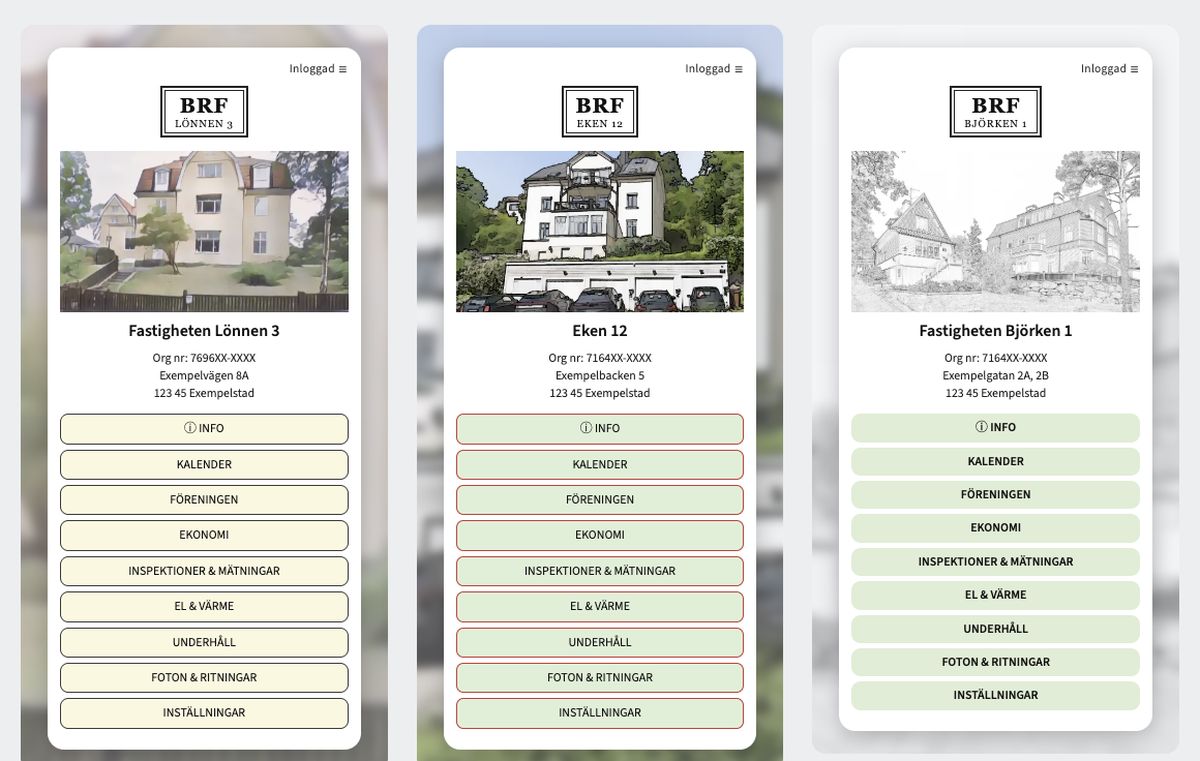
Blippa BRF is built for this. The cooperative receives QR stickers at the property and puts up one or more, for example on the door frame. A sticker is activated the first time it is scanned. The board uploads minutes, contracts, inspections and drawings and invites the people who should have access. They log in with BankID, the Swedish e-ID. Every cooperative's page has the same sections: info, calendar, association, finances, inspections and measurements, electricity and heating, maintenance, and photos and drawings. Each cooperative gets its own logo, a picture of the building and its own colours. The documents belong to the property and stay when the board changes. An object in Blippa can have more than one QR code, so a building with several entrances can have one in each.
A QR code does not change two things. The law says the OVK certificate must be posted and the energy performance certificate displayed in a clearly visible place in the building, so the paper stays on the wall. And if the cooperative wants to send meeting notices and other information electronically, the conditions in Chapter 1, Section 16 of the Economic Associations Act apply: the general meeting must have decided on it, the cooperative must have reliable routines for identifying the recipient, and the recipient must have consented.
More examples of pages behind a QR code are among Blippa's microsites and in the films of microsites in use, where the cooperative's binder is one of them. What a page can do, such as forms, booking and login, is listed under features.
Checklist for the board
- Check that the certificate from the latest OVK is posted and that the date of the next inspection has not passed.
- Check that the energy performance certificate is no more than ten years old and that a summary is posted at the entrance.
- Read in the statutes how meeting notices must be given, and post the notice within the time limits if the notice board is one of the channels.
- Post contact details for the board and the property manager, and a line on how to report a fault.
- Keep minutes, contracts, inspection protocols and drawings in one place that does not leave with an individual board member.
- Decide who has access to what, and who removes access when someone leaves the board.
- Put a QR code at each entrance and scan it with a few different phones before it goes up.
The same idea as a digital product passport
A QR code that belongs to a building rather than to a person follows the same idea as the EU's digital product passport under the Ecodesign Regulation (EU) 2024/1781: one fixed address per item, with the information following the item. Product passports are required for the product groups that EU legislation names, and Blippa builds them in DPP Agent (dppagent.com). DPP Academy explains what a product passport is and how its address works.
Frequently asked questions
What must be posted on the stairwell notice board in a Swedish BRF?
By law, two things: the certificate from the latest OVK inspection (Planning and Building Ordinance, Ch. 5, Sec. 6) and the energy performance certificate (Act on Energy Performance Certificates for Buildings, Sec. 13). The rest is decided by the statutes and the board.
How often is OVK required in an apartment building?
Every three years with FT or FTX ventilation and every six years with F, FX or S ventilation, under Section 3 of Boverket's regulations BFS 2011:16.
Who is responsible for the energy performance certificate in a housing cooperative?
The cooperative, because it owns the building. When an apartment is sold, the seller is responsible for stating the energy class in the advertisement and for showing and handing over the certificate.
Must the notice of the general meeting be posted in the stairwell?
Only if the statutes say so. Members must be called the way the statutes specify, and the notice of an ordinary meeting must be issued between six and four weeks before the meeting, or at the latest two weeks before if the statutes allow it.
Can a QR code replace the notices in the stairwell?
Not the ones the law requires. The OVK certificate and the energy performance certificate must be in a clearly visible place in the building. A QR code can hold the rest, such as contact details, fault reporting and the cooperative's documents behind a login.
Sources
- Planning and Building Ordinance (2011:338), Ch. 5, Secs. 1, 5, 6, 8, 13 and 14, riksdagen.se (in Swedish)
- Boverket's regulations on ventilation inspections, BFS 2011:16 (consolidated), Sec. 3 (in Swedish)
- Act (2006:985) on Energy Performance Certificates for Buildings, Secs. 5 and 13, riksdagen.se (in Swedish)
- Boverket: Buildings that require an energy performance certificate (in Swedish)
- Economic Associations Act (2018:672), Ch. 1, Sec. 16 and Ch. 6, Secs. 17 and 21, riksdagen.se (in Swedish)
- Tenant-Ownership Act (1991:614), Ch. 9, Sec. 14, riksdagen.se (in Swedish)
- Civil Protection Act (2003:778), Ch. 2, Sec. 2, riksdagen.se (in Swedish)
- Regulation (EU) 2024/1781 (Ecodesign for Sustainable Products Regulation), EUR-Lex