
European Union (EU) Digital Product Passport (DPP) Compliance oversight
The EU Digital Product Passport (DPP) is a central initiative under the Ecodesign for Sustainable Products Regulation (ESPR, Regulation (EU) 2024/1781). It aims to provide detailed information about a product’s materials, origin, repairability, and lifecycle. This is part of the EU’s Circular Economy Action Plan and applies to all physical products sold in the EU, including Sweden. Non-compliance could result in market bans or fines.
Key Points:
- What is DPP? A digital record for products to track origin, composition, and lifecycle.
- Who does it affect? Manufacturers, importers, and distributors selling in the EU.
- Timeline: The first product categories (e.g., textiles, furniture) will require DPPs starting in 2027.
- Sweden’s role: Swedish authorities like Swedac will enforce compliance through audits and inspections.
- Next steps for businesses: Start preparing by updating systems, gathering supply chain data, and piloting DPP workflows.
Swedish companies must act now to meet these requirements and maintain market access. Tools like Blippa simplify compliance by offering templates and digital hosting solutions.
Navigating the Digital Product Passport: What are Your Compliance Obligations? | Compliance & Risks
EU Regulatory Framework and Governance
The European Commission introduced the Digital Product Passport (DPP) framework as part of the ESPR (Regulation (EU) 2024/1781), connecting it to customs operations, market oversight, and broader sustainability goals. In July 2024, the Commission officially passed this legislation, setting a new benchmark for transparency and accountability within the EU market. Below, we’ll explore the Commission’s role, sector-specific requirements, and the technical standards that make DPP data interoperable.
European Commission‘s Responsibilities

The Commission is tasked with outlining the data each DPP must include and the structure it should follow. These guidelines are implemented through delegated acts, which outline specific obligations for various product groups. According to the 2025–2030 ESPR Working Plan, the first of these delegated acts is expected in late 2025, focusing on key categories like textiles, furniture, iron, steel, aluminium, and energy-related products. These acts will also introduce mandatory standards, such as unique product identifiers, and establish rules for DPP service providers, with finalisation anticipated by the end of 2025.
In addition to technical standards, the Commission integrates DPPs into customs processes and market surveillance systems. Customs authorities will use unique product identifiers to verify compliance with regulations, such as the Carbon Border Adjustment Mechanism (CBAM) and the Import Control System 2 (ICS2 Release 3). For instance, under the EU’s Detergents Regulation, detergents must be linked to a unique identifier in a central EU registry, enabling customs to verify compliance during import checks. Similarly, market surveillance authorities rely on DPP data for audits, compliance checks, product recalls, and verifying ethical sourcing practices.
Sector-Specific Regulations and DPP Integration
DPP requirements differ based on the product category, with delegated acts specifying the necessary data fields, reporting formats, and methodologies for each sector. In April 2025, the Commission introduced the first batch of products under the ESPR, covering items like textiles, furniture, tyres, and mattresses, as well as intermediate materials such as aluminium, iron, and steel.
The EU Batteries Regulation (EU 2023/1542), which took effect on 17 August 2023 and will fully replace the older Battery Directive by 18 August 2025, mandates a unique Battery Passport for all electric vehicle and industrial batteries over 2 kWh sold in the EU starting 18 February 2027. Similarly, the Critical Raw Materials Act (CRMA), effective from June 2024, requires products containing permanent magnets over 0.2 kg to disclose the proportion of critical raw materials recovered from post-consumer waste by 24 May 2027. These regulations will be rolled out in phases, targeting sectors like batteries and detergents first, with a mid-term review in 2028 to assess broader application.
Technical Standards and Data Interoperability
To ensure consistency across borders, harmonised technical standards form the backbone of the DPP framework. These standards are developed through harmonised specifications published in the Official Journal of the EU or through implementing acts by the Commission. Specifications cover unique product identifiers and data formats, with the launch of a central DPP registry planned for July 2026. These identifiers will link products, economic operators, and manufacturing facilities, ensuring seamless integration across different platforms and systems.
Uniform data formats and access protocols allow DPPs to work smoothly with EU digital systems, including customs databases and platforms like the European Chemicals Agency. Delegated acts also require that DPP data remains accessible even after a product is withdrawn from the market. This ensures that information is available throughout the product’s lifecycle, supporting circular economy initiatives and enabling authorities to trace products long after their initial market entry.
Sweden’s Enforcement and Oversight Mechanisms
Swedish Market Surveillance Authorities (MSAs)
Sweden ensures compliance with Digital Product Passport (DPP) standards through its Market Surveillance Authorities (MSAs), which are responsible for enforcing EU regulations at the national level. These authorities oversee the implementation of EU directives, focusing on health and safety requirements and ensuring manufacturers meet these standards. A key player in this effort is Swedac (the Swedish Board for Accreditation and Conformity Assessment), which coordinates quality and safety measures across the board.
In December 2025, Swedac, Tullverket, and 12 other agencies introduced a national strategy aimed at eliminating hazardous products and supporting ethically responsible businesses. Enforcement of DPP requirements is set to roll out for certain product categories, such as textiles, starting in July 2027. Swedish MSAs will conduct inspections and audits to verify compliance. The DPP framework simplifies this process by providing detailed sustainability data across a product’s lifecycle, making checks faster and more efficient. This system also supports a coordinated approach to market surveillance across the EU.
Cross-Border Coordination with EU Member States
Swedish authorities work within the harmonised EU framework, where most product regulations are standardised across member states. As a notifying authority, Swedac plays a central role in coordinating these efforts, collaborating with other EU countries and the European Commission. For products not covered by harmonised rules, Swedish authorities use Product Contact Points to share information with their counterparts in other EU nations, ensuring clarity on national requirements. This cross-border collaboration strengthens enforcement and addresses compliance challenges that arise in interconnected markets.
Swedish Industry Initiatives and Preparation Programs
Beyond regulatory measures, Swedish industries are taking active steps to prepare for the DPP framework. For instance, the APPEND project, backed by Vinnova, is helping the furniture industry integrate DPPs into their processes using tools like advanced CMS, QR codes, and blockchain technology. Similarly, in 2025, the Swedish fashion retailer Kappahl began testing Digital Product Passports as part of broader industry efforts to adapt to upcoming EU legislation. These initiatives not only demonstrate readiness but also highlight how Swedish businesses are embracing new technologies to meet future regulatory demands.
sbb-itb-256b3ff
Economic Operators and Service Provider Obligations
Manufacturer and Operator Legal Requirements
Manufacturers, importers, and distributors have a responsibility to ensure their products meet EU standards before entering the Swedish or EU market. This includes maintaining accurate, verifiable, and regularly updated Digital Product Passport (DPP) data. The DPP data must fulfil three key requirements:
- Transparency: Regulators must be able to audit claims with ease.
- Accessibility: Customers should have access to scannable digital records, often provided via QR codes.
- Shareability: Data must be easily shared with both upstream suppliers and downstream distributors.
Economic operators must compile structured digital records that document critical product details such as origin, material composition, environmental performance, repairability, and compliance throughout the product’s lifecycle. This ensures legal accountability for the accuracy of the data provided.
Non-EU Manufacturers and EU Representatives
Non-EU manufacturers are not exempt from these requirements. The DPP framework applies to all products sold within the European market, regardless of where they are manufactured. Non-EU manufacturers must meet the same compliance standards, while importers and distributors are tasked with verifying DPP compliance before products are placed on the market.
To maintain compliance, non-EU manufacturers should implement internal systems for collecting and validating supply chain data digitally. These systems must align with DPP categories to ensure consistency across markets. This creates a level playing field for all economic operators, whether they are based within or outside the EU.
Using Blippa for DPP Creation and Management
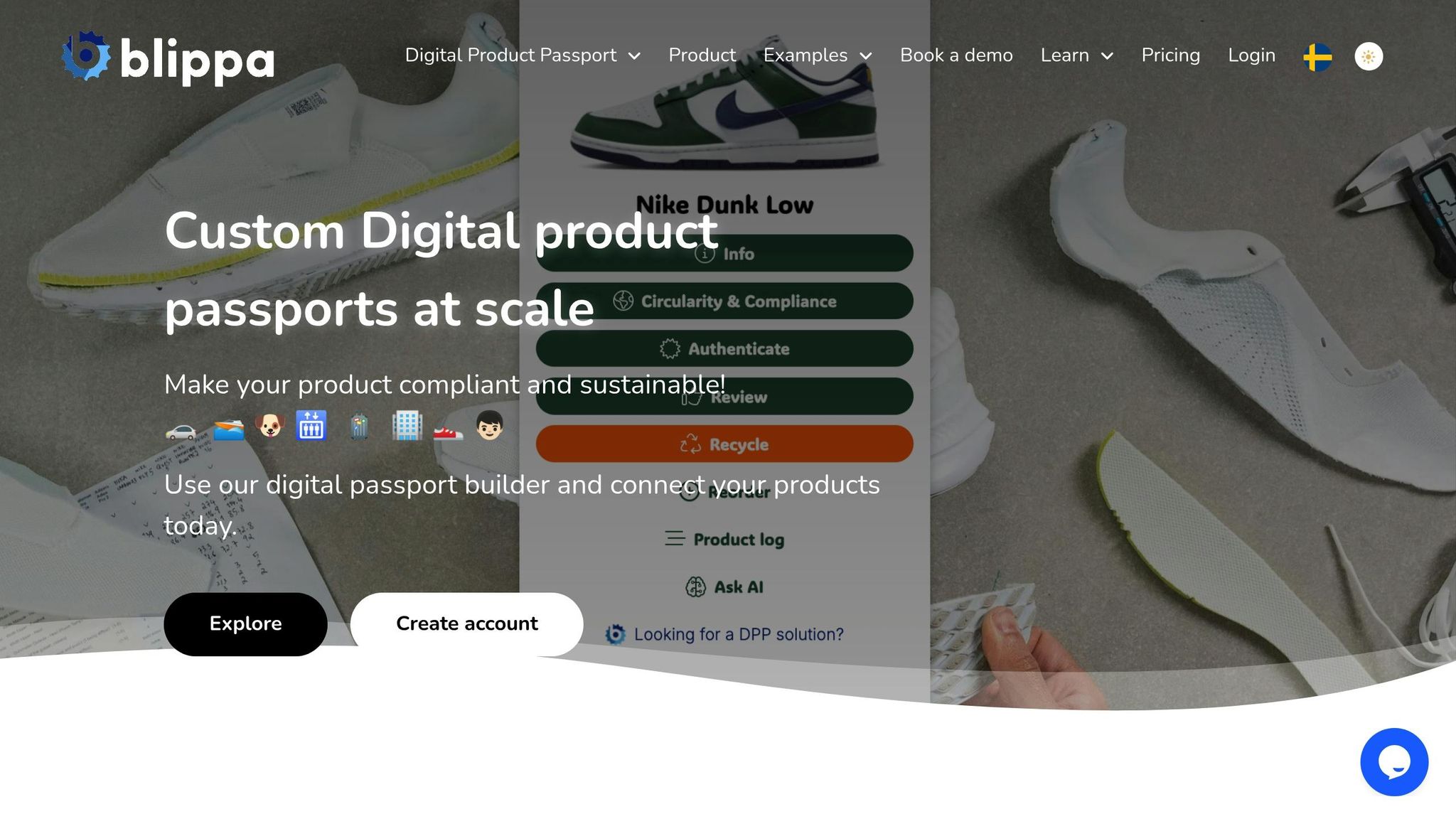
Service providers like Blippa offer practical solutions for managing these legal requirements. Blippa’s no-code platform simplifies the creation of compliant DPPs by providing:
- Pre-built templates
- Integrated QR code functionality
- Cloud-based hosting with version control
- User and role management
- Options for custom domains and third-party integrations
These features are particularly valuable for larger organisations, enabling efficient digital traceability and smoother compliance throughout a product’s lifecycle. Blippa’s tools help streamline the process, making it easier for businesses to meet regulatory demands without unnecessary complexity.
DPP Compliance Process: EU and Swedish Implementation
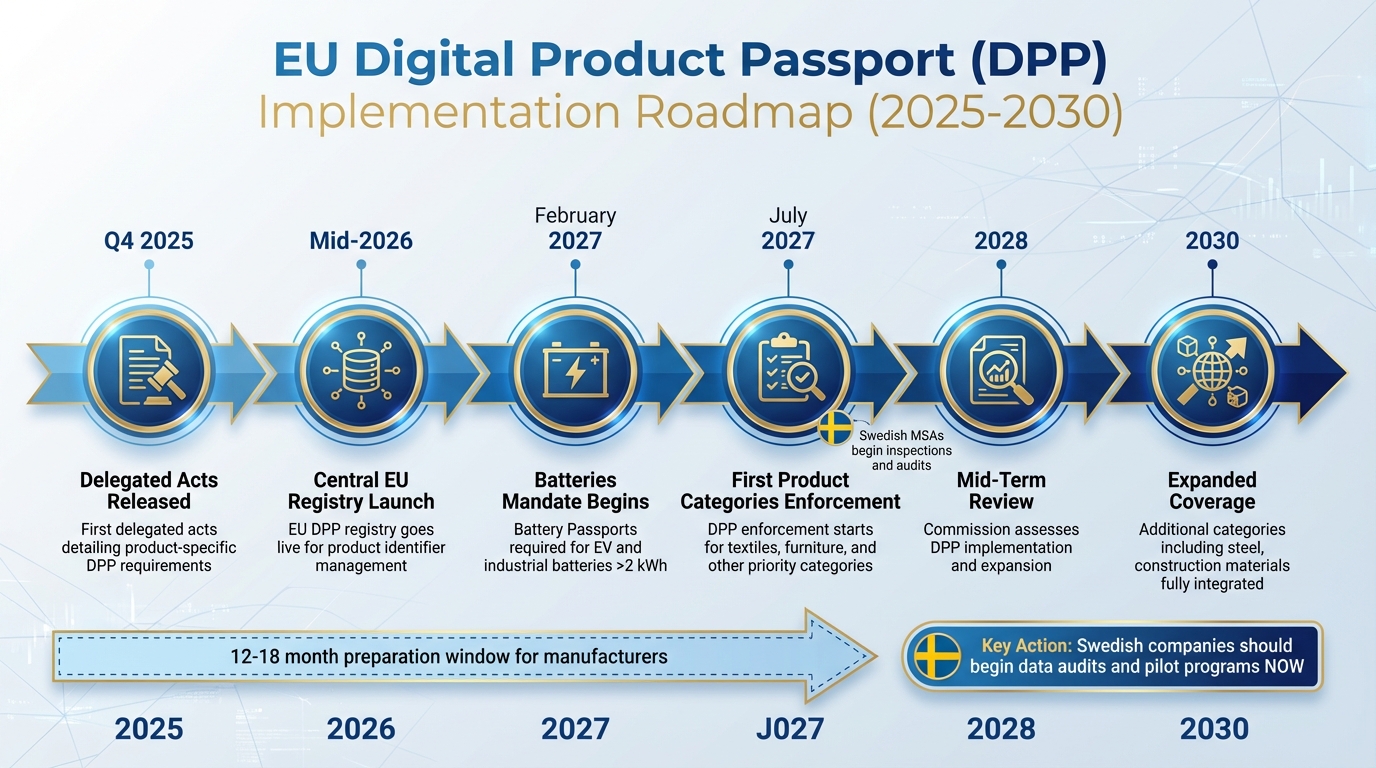
EU Digital Product Passport Implementation Timeline 2025-2030
Compliance Lifecycle and Stakeholder Responsibilities
The journey to Digital Product Passport (DPP) compliance kicks off with the European Commission’s establishment of the ESPR framework. This framework outlines delegated acts that detail specific requirements for various product categories. These delegated acts are set to roll out in Q4 2025, with a central EU registry expected by mid-2026. Batteries will be the first mandated product category, starting in February 2027, with additional categories like textiles, steel, and construction expected by 2030.
For manufacturers, this timeline means planning ahead. They’ll need 12–18 months to update internal systems and secure collaboration from suppliers. Swedish companies, in particular, should stay vigilant for regulatory updates and align their processes as the DPP scope expands. This includes revising governance protocols to ensure data accuracy and consistency across the board.
Once products hit the market, Swedish Market Surveillance Authorities will step in to inspect and audit DPPs. They’ll check compliance, verify that DPPs are properly filled out, and ensure they’re accessible under EU regulations. Non-compliance can lead to hefty fines, market bans, and a loss of customer trust. Harmonised technical requirements, adopted through implementing acts, aim to create consistency across Member States, reducing fragmentation and streamlining cross-border enforcement. These measures clearly define the roles of the European Commission, national authorities, and economic operators, setting the stage for smooth implementation.
Oversight Roles: Commission, Authorities, and Operators
| Stakeholder | Primary Responsibilities | Key Activities |
|---|---|---|
| European Commission | Establishes legal and technical frameworks | Develops delegated acts, sets up the EU DPP registry, coordinates digital infrastructure, and ensures harmonised standards. |
| Swedish Market Surveillance Authorities | Enforces compliance in Sweden | Conducts inspections, audits DPP accessibility, issues penalties for non-compliance, and collaborates with other Member States. |
| Economic Operators (Manufacturers, Importers, Distributors) | Manages DPP data | Compiles and updates product information, ensures data is transparent and accessible, and secures independent hosting for DPPs. |
Digital tools play a critical role in simplifying these oversight responsibilities, helping stakeholders bridge the gap between regulatory demands and daily operations.
Digital Tools for Compliance Management
Digital solutions, like Blippa’s no-code platform, make compliance management more efficient by automating data structuring, ensuring transparency, and enabling version control. These tools are designed to help businesses meet the core requirements of DPP compliance: maintaining transparent, accessible, and shareable product data.
"Implementing a Digital Product Passport isn’t just about meeting new legal requirements. It’s a chance to organise your product data processes to benefit both the business and your customers. The key is a clear process map and well-defined responsibilities – it’s worth starting with simple solutions and only then thinking about automation and IT integration."
– Damian Gierczak, Head of B2B Transformation, Univio
To ease into compliance, businesses are advised to start small. Piloting the DPP workflow with a single product line can help identify process gaps and refine operations. Running structured data audits can reveal missing information on sourcing, repairability, sustainability metrics, and end-of-life guidance. Additionally, training staff on DPP requirements and partnering with service providers for hosting solutions will ensure companies stay audit-ready as enforcement ramps up in Sweden and across the EU.
Conclusion
DPP compliance is not just another box to tick – it’s a legal requirement under the EU Ecodesign for Sustainable Products Regulation, impacting nearly all physical products sold within the European market. For Swedish businesses, ignoring this mandate could lead to penalties, especially as national Market Surveillance Authorities increase enforcement efforts. But beyond avoiding fines, embracing DPP compliance now offers a chance to gain a competitive edge.
The advantages go far beyond legal adherence. Early compliance doesn’t just satisfy regulators – it builds trust with consumers. For instance, 58% of consumers report that transparent supply chains improve their trust in a brand, and two-thirds factor durability or repairability into their purchasing decisions. On a larger scale, fully adopting Digital Product Passports could unlock an estimated US$700 billion in circular-economy revenue. This is particularly appealing to Gen Z consumers, who value authenticity and are willing to reward it with loyalty and even higher spending.
Operational efficiency is another key benefit. Tools like Blippa’s no-code platform simplify the process by centralising product data and automating traceable exchanges. This creates a single, reliable source of information, reduces manual work, and ensures consistency across teams and supply chains.
For Swedish companies, the time to act is now. Start by conducting structured data audits, aligning with suppliers on data requirements, and piloting DPP workflows with a single product line. Businesses that move quickly will not only meet regulatory demands but also tap into new revenue opportunities and streamline operations.
FAQs
How can Swedish companies prepare now for EU Digital Product Passport (DPP) compliance?
Swedish companies need to get acquainted with the EU’s Digital Product Passport (DPP) requirements, introduced under the Ecodesign for Sustainable Products Regulation (ESPR). A good starting point is ensuring that your product data management systems can handle and maintain precise, comprehensive product information.
It’s wise to appoint a team or specific individuals to take charge of data accuracy and compliance efforts. Stay in regular contact with Swedish market surveillance authorities to keep abreast of important timelines and enforcement updates. On top of that, take a close look at your supply chain and distribution processes to confirm that all your products align with both EU and Swedish DPP standards.
What do non-EU manufacturers need to know about the Digital Product Passport (DPP) requirements for selling in the EU?
Non-EU manufacturers aiming to sell their products in the EU must ensure their goods meet the Digital Product Passport (DPP) standards. These requirements, established under the EU’s Ecodesign for Sustainable Products Regulation (ESPR), demand transparent and verified details about a product’s lifecycle, environmental impact, and compliance.
To navigate these regulations, non-EU manufacturers are required to appoint an EU-based economic operator, such as an importer or an authorised representative, to serve as the official compliance contact. Missing the mark on DPP compliance can result in serious consequences, including limited access to the EU market, financial fines, or damage to the company’s reputation.
What are the risks of not complying with EU Digital Product Passport (DPP) regulations?
Non-compliance with the EU Digital Product Passport (DPP) regulations can result in severe penalties, such as substantial fines, product prohibitions, and even legal proceedings. Beyond these immediate risks, businesses could suffer damage to their reputation and potentially lose access to the lucrative EU market.
Moreover, failing to adhere to DPP standards can create significant operational challenges. Non-compliant products might be detained at customs or pulled from shelves by regulatory authorities, causing disruptions that could ripple through supply chains. Meeting these requirements is not just about avoiding penalties – it’s crucial for preserving trust, ensuring market access, and aligning with sustainability objectives.