
ERP and PIM Integration for DPP: Tools to Use
Swedish businesses must act fast to meet EU’s Digital Product Passport (DPP) requirements. These passports, mandated under the EU’s Circular Economy Action Plan, will soon be required for products sold in the EU market. Starting in 2026 with batteries and expanding to textiles, electronics, and more by 2027, DPPs demand extensive product data – from material origins to carbon footprints.
The challenge? ERP systems manage operational data, while PIM systems handle product details like certifications. Without integration, companies face inefficiencies and compliance risks. Here’s how to bridge the gap:
- Blippa: A no-code DPPaaS platform for merging ERP and PIM data, automating compliance with DPP compliant link management.
- Middleware/iPaaS: Scalable tools for large enterprises, offering AI-driven mapping and cloud-based integrations.
- Direct APIs: Custom ERP-PIM links for smaller setups, ensuring precise data flows.
Each solution has its strengths, but the right choice depends on your company’s size, IT resources, and urgency for compliance. Delaying action risks losing access to the EU market.
ERP and PIM Integration Masterclass: How, Why, and When to Integrate
1. Blippa
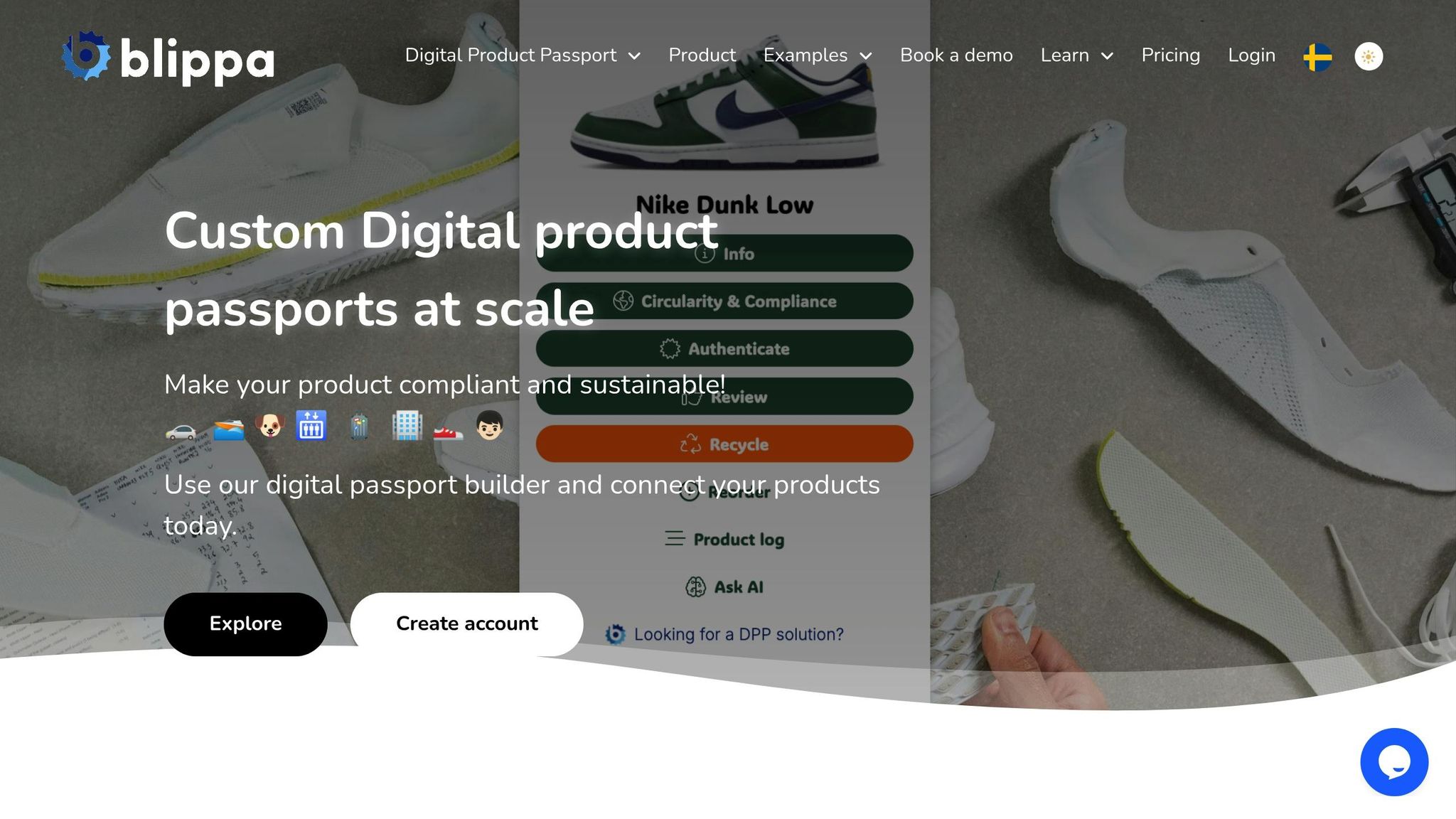
Blippa is a DPP platform designed to help companies seamlessly manage Digital Product Passports (DPPs) by connecting ERP and PIM systems.
DPP Data Mapping
Blippa simplifies the process of consolidating product, material, and sustainability data into a single digital twin. It does this by automatically merging operational details from ERP systems – like manufacturing lot numbers and procurement records – with sustainability attributes stored in PIM systems. This automation eliminates the need for manual data transfers, making system connectivity smooth and efficient.
Integration Flexibility
With Blippa, real-time synchronisation is possible thanks to its support for third-party integrations via REST APIs. It also provides a staging environment where companies can test data flows before going live, reducing the risks often associated with system integration.
Compliance with EU DPP Standards
Blippa ensures businesses stay compliant with EU regulations, including the ESPR requirements. Each product is assigned a unique digital identity through serialised DPP carrier codes for QR, RFID and NFC tags, enabling item-level traceability.
2. Middleware and iPaaS Platforms
Middleware and iPaaS platforms act as essential connectors between ERP and PIM systems, making them indispensable for Swedish companies gearing up for the EU’s Digital Product Passport (DPP) requirements. These regulations, coming into effect in 2025, demand businesses to document hundreds of additional data points for each product.
DPP Data Mapping
iPaaS platforms leverage AI to map ERP product data directly to DPP schemas. This automated approach is critical for managing the growing data demands of compliance. For instance, some companies are now handling over 130,000 assets simultaneously through ERP-integrated modules. These platforms ensure that only the most relevant and up-to-date data is included in the Digital Product Passport. For businesses with static product catalogues, updates can be made efficiently using CSV imports, targeting only modified records.
Integration Flexibility
iPaaS solutions are designed to support a broad range of protocols, including REST APIs, ODATA, SOAP, and CSV/Excel imports, making them adaptable to various system architectures. For example, over 118,000 businesses currently use API-driven platforms like Pimcore to streamline product data management.
A case in point is ADB SAFEGATE, which implemented the Inriver PIM to enable seamless integration from their SAP ERP to web platforms. This move harmonised product data and enhanced operational efficiency across departments. The platform’s bi-directional synchronisation ensures that while the ERP remains the master source for core data, the PIM can enrich and feed sustainability data back into the system. This middleware approach complements other direct integration and no-code solutions discussed later.
Scalability and Performance
Cloud-based iPaaS platforms are built to handle everything from small-scale pilots to enterprise-level operations, managing millions – or even billions – of product items. This scalability is crucial as DPP requirements grow. For instance, by 18 February 2027, all industrial and electric vehicle batteries over 2 kWh must include a mandatory Battery Passport accessible via QR code. iPaaS automation can dramatically cut review cycles by up to 90% and reduce production times by 75%, thanks to automated data distribution. Unlike static imports, these platforms enable real-time data synchronisation, keeping DPP information accurate as regulatory updates continue through 2030.
Compliance with EU DPP Standards
iPaaS platforms come equipped with built-in data validation tools to check for completeness, quality, and consistency before data is finalised for the Digital Product Passport. Many of these solutions support the Asset Administration Shell (AAS) standard, which offers a universal language for product data across supply chains. They also adhere to GS1 Digital Link standards, ensuring QR codes remain interoperable across various stakeholders. This automated validation is particularly valuable for meeting REACH and RoHS compliance requirements, allowing middleware to identify data issues at scale and ensure full compliance. These robust validation features set the stage for comparing integration methods in the next section.
sbb-itb-256b3ff
3. Direct ERP–PIM APIs
Direct API connections between ERP and PIM systems provide a streamlined solution for Swedish businesses aiming to meet DPP compliance standards. Unlike middleware solutions, these APIs create a direct data link, offering precise control over how data flows and is mapped between systems.
DPP Data Mapping
Direct REST APIs use standard formats like JSON and ODATA to transfer detailed product information between ERP and PIM platforms. This structured approach is vital for aligning existing PIM data with the requirements of the DPP. The ERP system maintains master data – such as unique identifiers and material origins – while the PIM focuses on enriching this data with sustainability attributes like recyclability and carbon footprint metrics. As stated by 4ALLPORTAL:
"Our philosophy is that the ERP should have absolute data sovereignty and remain the lead system for all master data".
This division of roles ensures that each system operates within its strengths, creating an efficient data-sharing framework.
Integration Flexibility
For optimal API performance, it’s critical to separate "hot" data (like real-time stock levels and price changes) from "cold" data (such as sustainability information). While dynamic data bypasses the PIM, static data remains enriched within it. Direct APIs also support bi-directional flows, allowing enriched sustainability data from the PIM to be sent back to the ERP as needed. Additionally, delta synchronisation ensures only new or updated records are imported, avoiding the inefficiency of re-importing entire catalogues – a key feature for businesses managing extensive product portfolios.
Scalability and Performance
Handling the increased data volume demanded by DPP compliance is a critical challenge for direct APIs. To maintain efficiency, systems should implement read-only defaults for PIM data fields, ensuring the ERP remains the authoritative source and avoiding accidental data overwrites. Features like webhooks can trigger outbound operations to third-party systems when specific DPP-related events occur. AI-powered data mapping further simplifies the onboarding of large datasets by automating schema alignment, enabling businesses to validate and resolve issues quickly. These measures not only handle high data volumes but also ensure compliance with strict EU standards.
Compliance with EU DPP Standards
Direct APIs play a crucial role in meeting the EU’s Ecodesign for Sustainable Products Regulation. As Crystallize explains:
"The DPP provides a standardised method for businesses to document and share required product data, streamlining regulatory adherence".
These APIs link real-time ERP data – such as sourcing details, manufacturing emissions, and material origins – with sustainability metrics in the PIM. By connecting unique identifiers like serial numbers or QR codes, they ensure traceability, enabling regulators to monitor ownership and recycling processes. Built-in validation tools also verify data completeness and consistency before finalisation, helping businesses meet regulatory requirements efficiently.
Comparison of Integration Methods
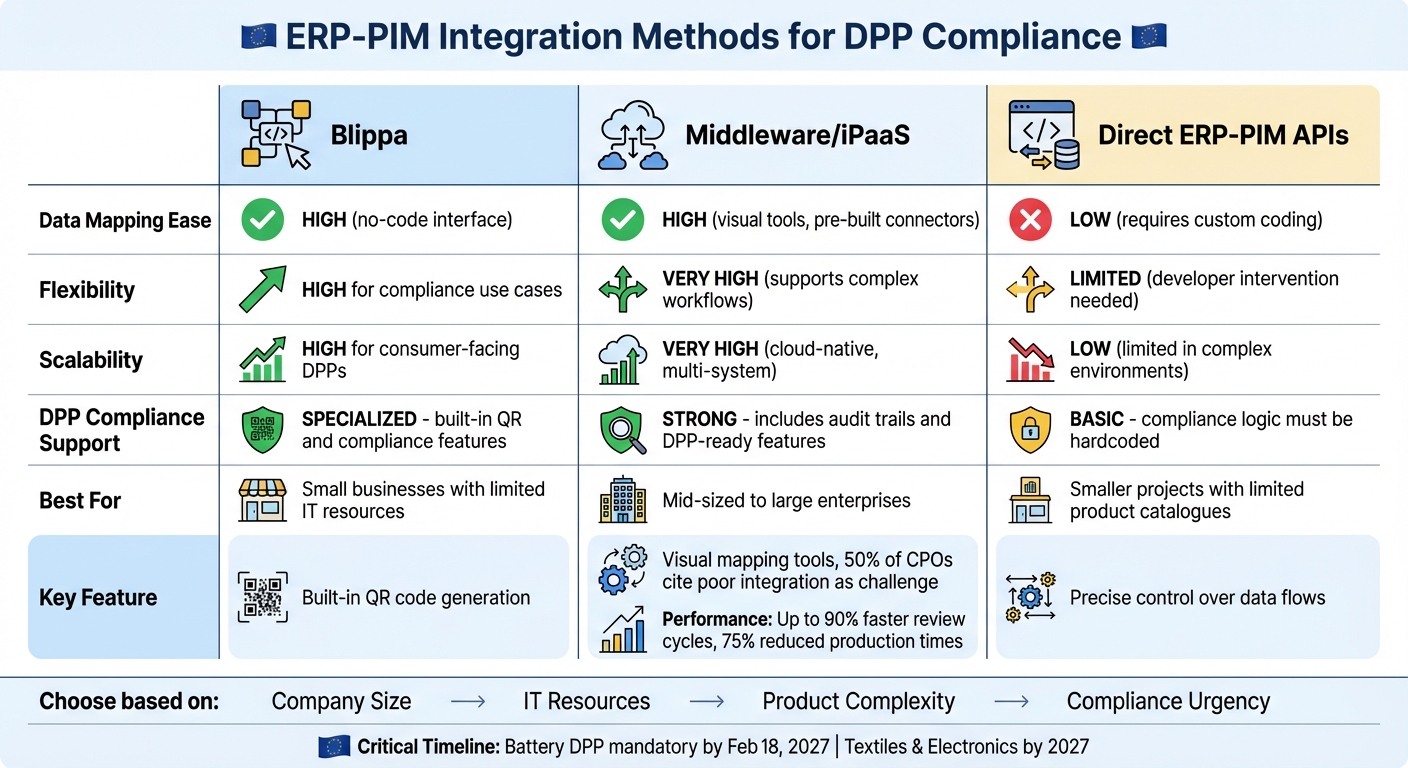
ERP-PIM Integration Methods Comparison for Digital Product Passport Compliance
Selecting the best integration approach for connecting ERP and PIM systems to support Digital Product Passports (DPPs) requires careful consideration of your organisation’s technical resources, product complexity, and compliance requirements. Below is a breakdown of the strengths and limitations of three popular methods, helping you navigate the path to effective DPP compliance.
Blippa offers a user-friendly, no-code platform that’s ideal for teams with limited IT resources. It simplifies the process with built-in DPP link management and QR code generation with compliance tools specifically tailored for DPP needs. Its no-code setup makes it a strong choice for organisations seeking quick and accessible solutions.
Middleware and iPaaS platforms are well-suited for large enterprises looking for scalability. These systems use visual mapping tools and pre-built connectors, reducing the need for manual API management. According to a Deloitte survey, nearly 50% of Chief Procurement Officers identified "poor integration across applications" as a major operational challenge. Middleware and iPaaS solutions also handle complex ETL processes and hybrid data models effectively, though they can be costly and complex to implement initially.
Direct ERP–PIM APIs offer a practical starting point for smaller projects with limited product catalogues. They provide precise control over data flows and work well for managing "cold" product data, such as sustainability attributes. However, these integrations require custom coding for attribute mapping, making them less scalable. This manual approach can become a bottleneck, especially for organisations needing to adapt quickly to evolving EU regulations.
| Integration Method | Data Mapping Ease | Flexibility | Scalability | DPP Compliance Support |
|---|---|---|---|---|
| Blippa | High (no-code interface) 100+ prebuilt API integrations | High for compliance use cases | High for consumer-facing DPPs | Specialised; Flexible DPP management and QR and compliance features |
| Middleware/iPaaS | High (visual tools, pre-built connectors) | Very high (supports complex workflows) | Very high (cloud-native, multi-system) | Strong; includes audit trails and DPP-ready features |
| Direct ERP–PIM APIs | Low (requires custom coding) | Limited (developer intervention needed) | Low (limited scalability in complex environments) | Basic; compliance logic must be hardcoded |
Each of these methods addresses the challenges of data accuracy and automation, which are critical for Swedish companies preparing for stricter EU sustainability regulations. Accurate data not only ensures compliance but also speeds up product launches, giving organisations a competitive edge in a rapidly evolving regulatory landscape.
Conclusion
Choosing the right integration method depends on factors like your company’s size, IT resources, and how urgently compliance is needed. This highlights how essential solid integration is in today’s competitive environment.
For smaller businesses with limited IT teams and straightforward product ranges, Blippa offers a practical solution. Its no-code setup eliminates the need for custom development while including built-in DPP management and DPP templates tailored for EU compliance, making it easier to deploy and manage DPPs quickly and over time.
Mid-sized businesses dealing with more complex product setups might benefit from middleware or iPaaS solutions. These options act as a central hub for communication between systems, reducing the risk of integration issues as your operations expand. They’re especially useful when connecting three or more systems while ensuring accurate data flow across all channels.
Larger enterprises with intricate global operations often require direct ERP–PIM APIs or advanced iPaaS solutions. While these methods demand a higher level of technical expertise, they provide the scalability and precision needed to handle vast and complex product portfolios. Regardless of the method, maintaining data integrity is critical. As Oleksandra Yavorska from AtroPIM points out, even though integration involves costs, it’s far more economical than separating PIM functions from ERP systems.
No matter the integration method, data sovereignty is key. Clearly defining system roles helps maintain data integrity. This approach avoids synchronisation conflicts and ensures each system excels in its specific function. Clear data ownership is equally important for running efficient and compliant operations.
FAQs
What are the main advantages of integrating ERP and PIM systems for Digital Product Passports?
Integrating ERP and PIM systems for Digital Product Passports (DPPs) creates a single, synchronised source of truth, ensuring accurate and up-to-date information is always accessible. This not only simplifies compliance with regulations but also boosts transparency and contributes to sustainability goals.
With automated data management, this integration minimises manual errors, optimises workflows, and reduces operational costs. It also makes it easier for businesses to track products and manage their lifecycle data – key elements for efficiently meeting DPP requirements.
How can Blippa help companies manage Digital Product Passports effectively?
Blippa offers a no-code platform that streamlines the process of creating and managing Digital Product Passports (DPPs), making it a practical choice for businesses. With features like a no-code editor, QR code generator, and built-in hosting, Blippa helps companies digitise their products, improve traceability, and support sustainability efforts.
The platform facilitates smooth team collaboration and version control, ensuring efficient workflows while easily connecting with third-party services. Its flexibility makes it suitable for a range of industries, including fashion, e-mobility, and real estate – aligning perfectly with Sweden’s commitment to innovation and environmental awareness.
What should companies consider when integrating ERP and PIM systems for Digital Product Passports?
When connecting ERP and PIM systems to manage Digital Product Passports (DPPs), it’s essential to focus on the type of data being shared. For static information like product descriptions, images, or sustainability attributes, simple batch imports (like CSV files) often do the job. But when handling dynamic data – such as pricing or stock levels – real-time synchronisation becomes critical. In these cases, APIs like REST or OData are typically the go-to solutions.
Another key factor is technical compatibility and scalability. Opt for platforms that provide strong API support or no-code tools, as these can make the integration process smoother and cut down on development expenses. Features like field mapping, data validation, and version control are particularly useful for ensuring data accuracy and meeting EU DPP requirements.
Finally, evaluate the operational fit of the integration. The system should support metric units, align with sustainability reporting standards, and scale effortlessly across various product lines or markets. Tools like Blippa can simplify this process with no-code templates, QR code creation, and easy integration with third-party platforms.