
Digital Product Passports for Recycling
Digital Product Passports (DPPs) are transforming how products are recycled by providing detailed, accessible data on materials, origin, and lifecycle. Linked to products via QR codes or RFID tags, DPPs help recyclers sort and process materials more efficiently, reducing waste and improving recovery rates. With the EU’s Ecodesign for Sustainable Products Regulation (ESPR) requiring DPPs for high-impact sectors like textiles and electronics by 2027, businesses must prepare now.
Key Takeaways:
- Why It Matters: Only 12% of industrial materials are recycled in the EU, with 11 kg of textiles per person discarded yearly.
- How DPPs Work: Scannable digital profiles provide recyclers with material breakdowns, recycling instructions, and hazardous substance alerts.
- Regulatory Push: The ESPR mandates DPPs for batteries, textiles, and electronics starting in 2027, expanding to 30+ product categories by 2030.
- Business Benefits: DPPs simplify compliance, improve recycling efficiency, and support circular business models.
Companies can use tools like Blippa to create DPPs quickly with no-code platforms, ensuring compliance and streamlining recycling processes. Early adoption not only meets legal requirements but also enhances operational efficiency.
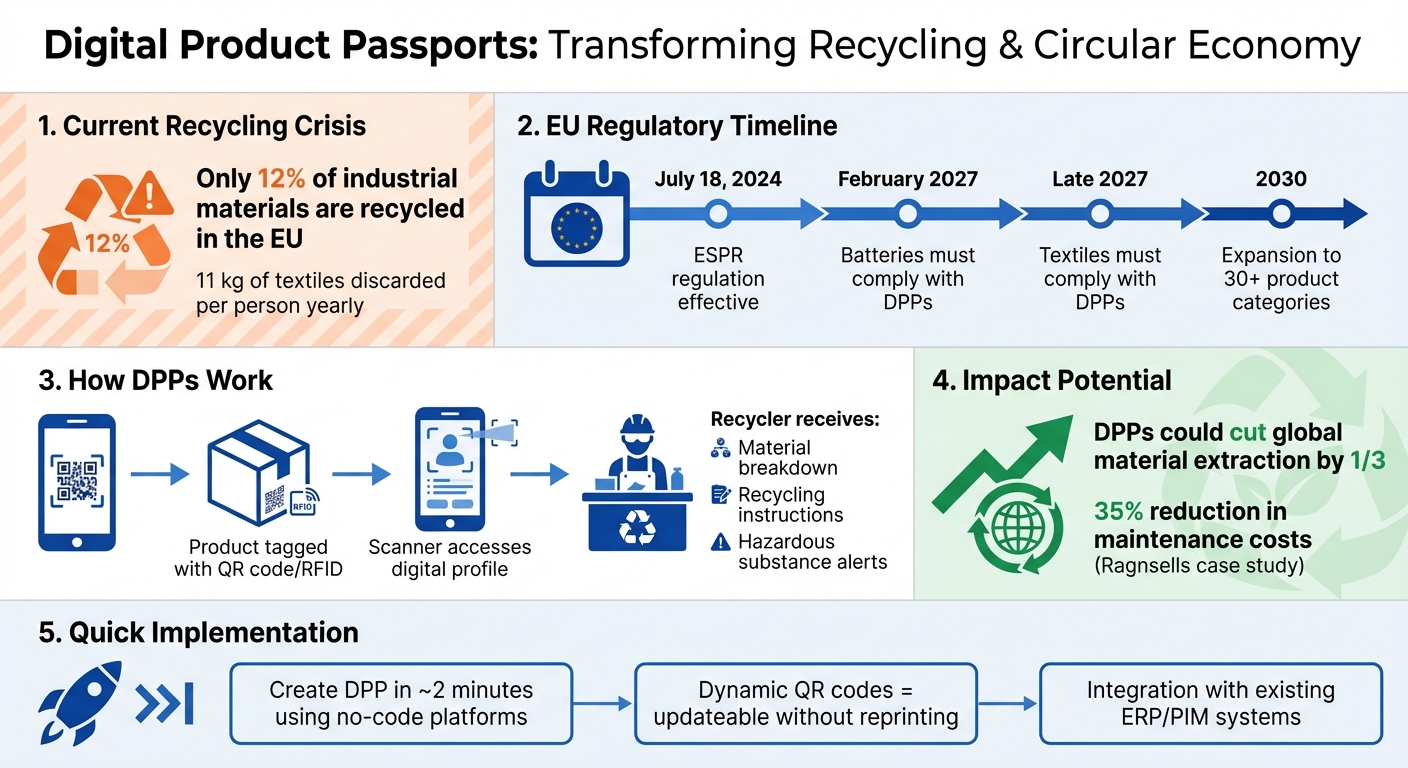
Digital Product Passports: Key Statistics and Implementation Timeline for EU Compliance
How Digital Product Passports Enable Recycling
Traceability and Material Sorting
Digital Product Passports (DPPs) assign a unique digital identity to each product using technologies like QR codes, RFID tags, or Data Matrix systems. By scanning these identifiers, recyclers can access detailed material information, making it easier to handle products, even when they contain mixed or hazardous components.
Take the Fibre Traceability Initiative as an example. By attaching QR codes to garments in the merino wool supply chain, the initiative tracked items from raw material to consumer. This process ensured recyclers had the necessary data for accurate sorting at the product’s end of life. Similarly, Axfoundation highlights how DPPs provide critical material data to prevent contamination and improve sorting accuracy.
This level of traceability also plays a central role in meeting legal obligations, as explained below.
Meeting Regulatory Requirements
The Ecodesign for Sustainable Products Regulation (ESPR), effective from 18 July 2024, mandates Digital Product Passports for high-impact sectors. Batteries must comply by February 2027, with textiles joining later that year. Acting as digital IDs, DPPs simplify compliance by enabling automated verification for all products.
In Sweden, businesses are already adapting to these changes. Organisations like GS1 Sweden, along with local user groups, are developing standardised data protocols to ensure companies align with EU regulations and industry-specific circularity goals. James Beard, Head of Voluntary Compliance at Valpak, emphasises the importance of early preparation:
"We are pleased to launch this additional offering to help textile producers navigate these evolving regulations, get ahead of the curve and ensure they understand and are well placed to deal with their obligations".
Higher Recycling Rates Through Standardised Data
Beyond regulatory compliance, standardising data enhances efficiency throughout the value chain. When data is structured using global frameworks like GS1 Digital Link or ITU-T L.1071, it becomes accessible and interoperable. This allows recyclers, repairers, and resellers to rely on verified details for disassembly and recycling processes.
The potential impact of DPPs on global sustainability is immense. By supporting a circular economy, tools like these could cut global material extraction by one-third. Pradeep Mahat, Circular Economy Standardisation Lead at Nokia, underscores the broader benefits:
"The DPP enables innovation in product design, usage, reuse, supply chain management, and end-of-life practices, thereby promoting circularity and reducing environmental impact across the entire value chain".
Benefits of DPPs for Businesses
Improved Operational Efficiency
Digital Product Passports (DPPs) simplify operations by centralising product information in one easily accessible place. Instead of wasting time on manual searches, technicians can scan a QR code to instantly access details like maintenance instructions, spare parts lists, or disassembly guidelines.
For businesses handling intricate supply chains, DPPs ease the workload by automating data exchanges between suppliers, manufacturers, and recyclers. Using open standards like GS1 Digital Link, product data integrates smoothly with existing Product Information Management (PIM) systems. Real-time updates ensure consistency across platforms, while automated compliance checks reduce the effort needed to meet EU regulations. This streamlined approach not only saves time but also supports broader transitions toward circular economy practices.
Supporting Circular Economy Practices
DPPs play a critical role in enabling circular business models by documenting essential details such as material composition, disassembly methods, and end-of-life guidelines. This verified data allows repairers, refurbishers, and recyclers to quickly evaluate a product’s potential for repair or recycling, fostering growth in second-hand markets.
By improving material recovery and reuse, DPPs help companies shift from linear production models to circular systems that extend product lifespans and reduce waste. This level of technical transparency is key to meeting recycling goals and supporting sustainable practices.
Building Brand Reputation
Streamlined operations and circular practices don’t just improve efficiency – they also enhance public perception. Implementing DPPs effectively can boost a company’s reputation by demonstrating a commitment to transparency and sustainability.
Swedish consumers are increasingly demanding access to reliable product information. DPPs meet this demand by offering verified sustainability data, countering concerns about greenwashing. As Pradeep Mahat from Nokia highlights:
"The DPP… will be a key tool to store and communicate verified and verifiable information on products across the value chain, making it an effective instrument to fight greenwashing".
In January 2024, Swedish retailer Kappahl and Finnish brand Marimekko partnered with GS1 Sweden and TrusTrace to pilot the Trace4Value project, testing DPP functionality. By aligning with strict EU regulations and consumer expectations, DPPs not only promote sustainable practices but also build trust. This transparency reassures consumers and underscores a company’s dedication to environmental accountability.
Pioneering Digital Product Passports with Nobody’s Child | Zebra
sbb-itb-256b3ff
How to Implement DPPs Using No-Code Platforms
Turning the concept of Digital Product Passports (DPPs) into a reality is now easier than ever, thanks to no-code tools. These platforms simplify the process, making it accessible for businesses of all sizes to create and manage DPPs without heavy technical expertise.
Creating DPPs with No-Code Tools
Getting started with DPPs can be surprisingly quick and straightforward. Take Blippa as an example – it allows businesses to register for a free account and publish an object page in just about two minutes. Each product gets a unique digital identity, essentially a dedicated web page containing all relevant information, such as recycling instructions and sustainability data.
Here’s how it works:
- Map your product data: Include details like material composition, carbon footprint, and recyclability. Pre-built templates handle the heavy lifting, including cloud hosting, so you don’t have to worry about the technical backend.
- Use dynamic QR codes: These codes are a game-changer. Unlike static QR codes, dynamic ones can be updated without needing to reprint labels. Blippa’s QR code generator creates these flexible identifiers, which are scannable by any smartphone – no special app required. High-contrast printing ensures the codes work well for both consumers and automated sorting systems.
With such tools, you can scale from small pilot projects to thousands of products with minimal effort. This ease of creation also paves the way for seamless integration into existing systems.
Integrating DPPs into Existing Systems
For DPPs to deliver their full potential, they need to fit into your current operations effortlessly. Integration with tools like ERP or Product Lifecycle Management systems ensures everything runs smoothly. Blippa provides APIs to help connect these platforms.
Role-based access controls are another key feature. They allow you to share the right information with the right people. For instance:
- Consumers can access repair guides and material details.
- Recyclers get insights into hazardous materials and disassembly instructions.
- Proprietary data stays protected, visible only to authorised users.
Dynamic QR codes also come with version control, which acts as a form of lifecycle management. Need to update compliance certificates or maintenance instructions? No problem – just update the digital record, no physical recalls required. Kiwa, for example, saved an average of 15 minutes per elevator inspection by switching to on-site QR code scanning instead of traditional reporting tools.
Pricing Options for Different Business Sizes
Blippa offers flexible pricing plans to suit businesses at every stage of their DPP journey. Here’s a quick breakdown:
- Basic Plan: Perfect for small businesses testing the waters. It includes core features like the no-code editor, pre-built templates, QR code generation, hosting, and notifications.
- Professional Plan: Designed for medium-sized businesses, this plan adds version control, user management, and role-based access – ideal for teams coordinating across departments or supply chains.
- Enterprise Plan: Tailored for large organisations, it includes advanced features like custom domains, on-premises hosting, and third-party integrations for managing complex data flows.
The best part? You can start with a free account to test the waters without any initial investment. Begin by focusing on essential regulatory data, such as material composition required by EU guidelines, and expand as your needs grow.
The financial benefits are hard to ignore. For example, Ragnsells reported a 35% reduction in maintenance costs over their products’ lifespans, thanks to predictive maintenance enabled by Blippa’s platform. Between operational savings, better compliance, and improved recycling outcomes, DPPs can be a smart move for businesses of all sizes.
DPPs in Action: Industry Examples
Manufacturing and Packaging Case Studies
The packaging sector is proving to be a frontrunner in adopting Digital Product Passports (DPPs). A notable example is the collaboration between Dow and HP Indigo, which has created a closed-loop recycling system using the R-Cycle database. This system tracks essential recycling data – such as plastic type, printing color, and recycled content – for PE-rich monomaterial pouches. By storing this information in standardized records accessible to industrial sorting facilities, the process ensures that recycled materials retain a high enough quality for effective reuse.
The R-Cycle initiative operates on a Software-as-a-Service (SaaS) model, delivering interoperable data to support manufacturing, sorting, and recycling processes. Its use of industry-standard GS1 protocols allows for large-scale implementation.
These advancements highlight how DPPs are reshaping traditional industries, setting the stage for similar innovations in the fashion sector.
DPPs in Fashion
Fashion brands are increasingly turning to DPPs to tackle the industry’s waste and transparency issues. In early 2024, Kappahl and Marimekko introduced pilot product lines featuring QR codes linked to the GS1 Digital Link standard as part of the Trace4Value project. These QR codes provide consumers with access to sustainability data, supplier information, and instructions for repair or recycling.
Halti, a Finnish outdoor clothing manufacturer, joined a Sitra-funded pilot to explore the digital and financial requirements for implementing DPPs. This initiative aligns with the EU’s vision for circular textiles by aiming to provide transparent product information. Meanwhile, the CIRPASS2 Workwear Project – supported by the European Commission and involving the Finnish Textile and Fashion Association alongside Ioxio – is focusing on creating data-driven DPP solutions specifically tailored to managing and recycling large-scale workwear inventories.
New Applications Across Industries
DPPs are also making their mark in other sectors. The SIX Mobile Work Machines consortium, which includes companies like Sandvik and Kalmar, is working on battery passports to monitor the lifecycle of industrial batteries used in e-mobility. These passports aim to optimize end-of-life processing and material recovery, ensuring better reuse and recycling outcomes.
In construction and real estate, the CIRPASS2 project is applying DPPs to construction materials. This approach improves maintenance tracking and facilitates material recovery when buildings reach the end of their lifecycle. Similarly, the Swedish furniture industry is developing "furniture passports" to enhance component traceability and support circular business models, making it easier to recycle complex products. In agriculture, projects like Agro2Circular are using DPPs to track plastics such as mulch films, ensuring proper identification for upcycling into new materials like Alfaten pellets, which helps cut down on agricultural waste.
These examples collectively show how DPPs are driving advancements in recycling and sustainability across a wide range of industries.
The Future of Recycling with DPPs
Key Benefits Summary
Digital Product Passports (DPPs) bring precision to recycling and the circular economy. By providing detailed product information, they help recyclers sort materials more effectively, reduce contamination risks, and increase recovery rates for reusable materials. They also make hazardous substance handling safer, enabling the recovery of high-quality secondary materials.
In fact, adopting circular economy practices supported by DPPs could cut global material extraction by a third. This aligns with EU regulations, which now require DPPs for market access.
"The DPP marks a major step toward a circular economy. By providing trustworthy and readily accessible product data, it will enhance transparency, traceability, and sustainable practices throughout the product life cycle."
– Pradeep Mahat, Managing Circular Economy Standardization Project, Nokia
But the benefits of DPPs go beyond compliance. They open doors to new business opportunities, such as launching Product-as-a-Service models, earning resale royalties in secondary markets, and building brand trust through verified sustainability data. These advantages make it clear: now is the time for businesses to act.
Next Steps for Businesses
To take advantage of DPPs, start by assessing your existing sustainability data – this includes details like material composition, country of origin, and recycling instructions. Identify what’s missing to comply with upcoming standards. Implement unique product identifiers, such as GS1 2D barcodes or QR codes, to connect physical products to their digital profiles.
Once gaps are identified, work closely with suppliers to gather the necessary data attributes. Participating in pilot programs like SwePass or CIRPASS can also help align your business with emerging standards.
If you’re looking for tools to simplify the process, Blippa offers a no-code platform for creating and managing DPPs. With features like a DPP generator, templates, and hosting, it integrates seamlessly into existing systems without requiring major infrastructure changes. Acting now will not only position your business to meet environmental goals but also improve recycling processes and drive progress toward a circular economy.
FAQs
How do Digital Product Passports make recycling more efficient?
Digital Product Passports (DPPs) play a key role in improving recycling processes by assigning a unique digital ID to products. This ID contains detailed, standardised information about the product, such as its material composition, chemical content, and clear instructions for proper handling at the end of its life.
With this information, recyclers can more easily identify, sort, and recover valuable materials. The result? Less waste, better resource conservation, and increased energy efficiency. This efficient approach aligns perfectly with Sweden’s commitment to environmental responsibility and the transition towards a circular economy.
What are the EU’s requirements for Digital Product Passports (DPPs)?
Under the Ecodesign for Sustainable Products Regulation (ESPR), starting 18 July 2024, companies manufacturing or importing physical products into the EU will need to provide a Digital Product Passport (DPP). This passport connects a unique identifier, like a QR code, to key product details. These details include material composition, hazardous substances, repair and recycling guidelines, carbon footprint, and compliance with ecodesign rules. However, some items – such as food, pet food, and medical devices – are excluded since they fall under separate regulations.
To ensure the effectiveness of DPPs, the European Commission has assigned standardisation bodies like CEN, CENELEC, and ETSI to define technical standards. These standards aim to make the data machine-readable, interoperable, and accessible throughout a product’s lifecycle. Businesses must ensure the passport is available at the point of sale, update it after servicing or refurbishment, and allow authorised parties to verify the data when required.
For companies navigating this new requirement, platforms like Blippa offer practical solutions. Their tools, such as a no-code editor and DPP generator, help businesses create unique product identifiers and organise sustainability data in a searchable, structured format.
How can businesses in Sweden easily implement Digital Product Passports (DPPs)?
Businesses in Sweden can implement Digital Product Passports (DPPs) effortlessly using no-code platforms like Blippa. The process is straightforward, aligning perfectly with Swedish standards for dates, numbers, and measurement units.
To get started, create a DPP project and use the no-code editor to design the passport. Include important details such as material composition, carbon footprint, and recycling instructions, all formatted to Swedish conventions – dates like 23/12/2025, numbers as 1 234,56, and metric units such as kilograms or °C. You can either customise a ready-made template or design one from scratch. Once your passport is ready, generate a QR code for quick and simple integration with your product.
After publishing, the passport is hosted online and linked to the product via the QR code, which can be printed on labels or packaging. Updates are hassle-free with built-in version control, ensuring that the most up-to-date information is always available. This approach not only helps businesses comply with EU regulations but also supports sustainability and product traceability.