
CIRPASS project
The CIRPASS project focuses on creating Digital Product Passports (DPPs) to streamline product lifecycle management and support the circular economy. These passports store key product details digitally, accessible via QR codes, enabling better reuse, recycling, and regulatory compliance. Funded by the EU, CIRPASS ran from October 2022 to March 2024, targeting electronics, batteries, and textiles, with expansion into tyres and construction in its second phase. Swedish partners like Chalmers Industriteknik and RISE are actively contributing, particularly in textiles and batteries.
Key highlights:
- Digital Product Passports (DPPs): Centralized digital records for products, improving transparency and lifecycle management.
- EU Regulations: ESPR (from July 2024) and Battery Passports (by 2026/2027) mandate DPP use.
- CIRPASS Deliverables: Frameworks, blueprints, and 67 recommendations for industries and policymakers.
- Sector Focus: Electronics (repair and recycling), textiles (reuse and recycling), and batteries (lifecycle tracking).
Swedish companies are encouraged to start pilot projects, address data gaps, and integrate no-code tools like Blippa for DPP creation. By 2030, DPPs aim to shift industries toward a circular economy.
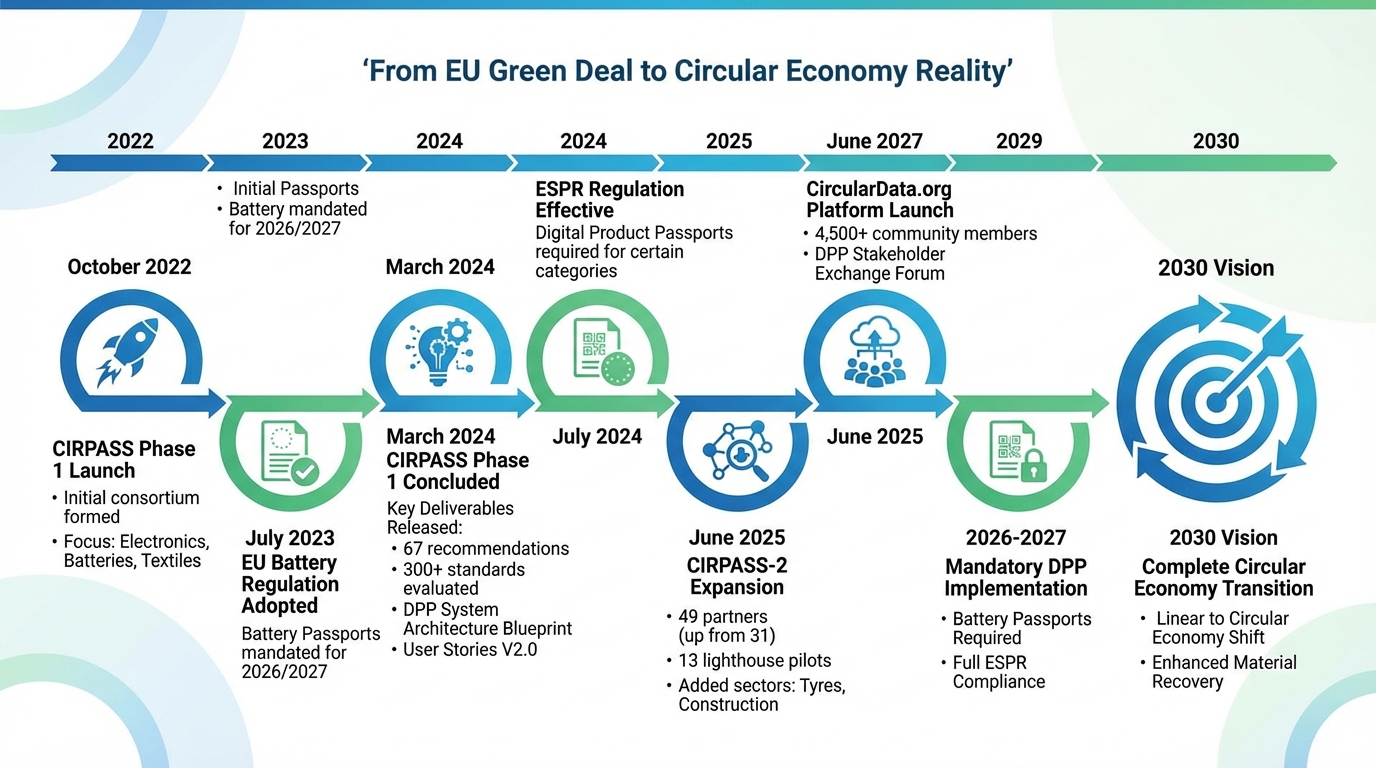
CIRPASS Project Timeline and Key Milestones 2022-2030
Digital Product Passports (DPP): A Key Component of EU Sustainability Regulations
CIRPASS Objectives and Deliverables
The CIRPASS project is all about making Digital Product Passports (DPPs) a practical reality, ensuring that regulatory requirements align with how industries operate.
Policy and Regulatory Background
CIRPASS was born out of the EU Green Deal and the Ecodesign for Sustainable Products Regulation (ESPR), which came into effect on 18 July 2024. These regulations bring significant changes to how products are designed, manufactured, and managed throughout their lifecycle. For instance, the ESPR requires DPPs for certain product categories. A notable example is the EU Battery Regulation, adopted in July 2023, which mandates Battery Passports for industrial and electric vehicle batteries by 2026/2027.
CIRPASS plays a foundational role in this evolving regulatory landscape by defining what the DPP system should look like and how it should operate. This ensures that businesses, policymakers, and technology providers are on the same page, setting the groundwork for the technical deliverables outlined below.
CIRPASS Deliverables and Blueprints
The project has produced a range of technical resources to support the real-world adoption of DPPs. One of the key outputs is the DPP System Architecture Blueprint, which uses a dual-track approach combining HTTP URIs and Decentralised Identifiers (DIDs). This approach ensures that data flow is anchored in reliable product identifiers.
Another important deliverable is the Identification Schemes Framework, which evaluates how products, economic operators, and facilities should be uniquely identified within the DPP system. This framework is based on 10 specific criteria. Additionally, CIRPASS mapped out the information requirements for batteries, electronics, and textiles. These requirements include both mandatory and optional data points that will guide future delegated acts under the ESPR.
The project also provided 67 actionable recommendations for policymakers, businesses, and IT service providers. These recommendations are complemented by sector-specific roadmaps that guide the journey from initial prototypes to full-scale implementation. Along the way, CIRPASS identified the key factors – both opportunities and challenges – that will impact successful DPP delivery.
An especially valuable resource is the standards dataset, which evaluates over 300 existing standards related to DPPs. Each standard is graded for relevance, helping companies navigate the complex technical environment. To connect regulatory goals with practical implementation, the project also developed DPP User Stories (V2.0). These stories illustrate how stakeholders can issue, manage, and use DPP data effectively. All these deliverables were created through collaboration with a wide range of stakeholders, as discussed below.
Stakeholder Ecosystem and Collaboration
Collaboration was at the heart of CIRPASS. The initial consortium brought together leading industrial, research, and digital organisations from across Europe and beyond. This diverse group ensured that the project’s outputs addressed the practical needs of different industries.
The project worked closely with standardisation bodies like GS1 and various European organisations to ensure that the proposed DPP vocabularies and protocols could evolve into recognised industry standards. This collaborative approach helped create a unified framework rather than fragmented, sector-specific solutions.
After the initial phase ended in March 2024, CIRPASS-2 expanded its reach. It grew to include 49 partners and 13 lighthouse pilots across four major value chains: textiles, electronics, tyres, and construction. In June 2025, the initiative launched circular-data.org, a platform designed to connect DPP stakeholders. This platform has since become the central hub for the DPP community, which now includes over 4,500 members working to turn regulatory requirements into practical solutions. This broad collaboration among industry leaders is critical for building the unified framework needed to make DPPs a success.
How DPPs Work in Different Sectors
Digital Product Passports (DPPs) are tailored to meet the specific sustainability and regulatory needs of different industries. The CIRPASS project has outlined the data requirements for three key sectors – electronics, textiles, and batteries – identified as priorities under the European Sustainable Products Regulation (ESPR). These sectors are expected to see mandatory DPP implementation by 2027.
In electronics, DPPs extend product lifetimes through repair and reuse. For textiles, they enable circular business models by supporting authenticated resale and recycling. Meanwhile, batteries benefit from lifecycle transparency, which ensures safe repurposing and efficient material recovery. Together, these applications strengthen trust in secondary markets and improve material recovery rates. Let’s take a closer look at how DPPs are shaping these industries.
Electronics: Repairability and Recycling Made Easier
For electronics, the CIRPASS framework focuses on collecting manufacturing data that encourages longer product lifetimes and circularity. This includes information like durability metrics, repairability scores (aligned with EU right-to-repair laws), detailed component hierarchies for disassembly, and sorting instructions for proper recycling.
This data makes repairs and recycling more efficient. For instance, if a consumer needs to repair a smartphone or laptop, the DPP provides access to disassembly guides and spare part details. At the end of a product’s life, recyclers can identify valuable materials and learn how to extract them safely. Max Winograd, Vice President of Digital Solutions at Avery Dennison, highlighted the collaborative effort behind these initiatives:
"Our work, in close collaboration with other project partners, will create standards-based DPP prototypes and an implementation blueprint for deploying an interoperable digital product passport sustainably at scale".
Textiles: Supporting Circular Fashion
In the textile industry, DPPs provide a detailed digital record for each product, covering fibre composition, material origins, environmental impact, and certifications. This transparency supports circular business models by offering clear instructions for care, reuse, and end-of-life recycling.
DPPs help extend product lifetimes and facilitate textile-to-textile recycling. For example, when consumers know the exact materials in a garment and how to care for it, the product lasts longer. Businesses also benefit by meeting consumer expectations – 43% of shoppers say transparency about a product’s origin and journey is important to them. For recyclers, precise fibre content data is critical for maintaining material quality in closed-loop systems, enabling more effective recycling processes.
Batteries: Tracking Every Stage of the Lifecycle
Battery passports, mandatory under the EU Battery Regulation, align with CIRPASS objectives by detailing key information such as sourcing, carbon footprint, recycled content, chemistry, capacity, and guidelines for repurposing. This comprehensive data ensures safe handling, optimises second-life applications, and improves material recovery efficiency.
sbb-itb-256b3ff
Implementing CIRPASS-Aligned DPPs with No-Code Tools
Swedish companies now have a practical way to align with CIRPASS’s technical guidelines using no-code tools, making compliance with upcoming regulations more accessible. With mandatory Digital Product Passports (DPPs) set to roll out by 2027, many businesses face the challenge of building digital infrastructure despite limited technical expertise or resources. No-code platforms offer a solution, automating the creation of data carriers and enabling smooth lifecycle data sharing between stakeholders and consumers [20,21]. This is especially helpful for small and medium-sized enterprises (SMEs) that lack in-house IT teams but still need to meet the Ecodesign for Sustainable Products Regulation (ESPR) requirements.
Blippa: A Tool for Scalable DPP Creation
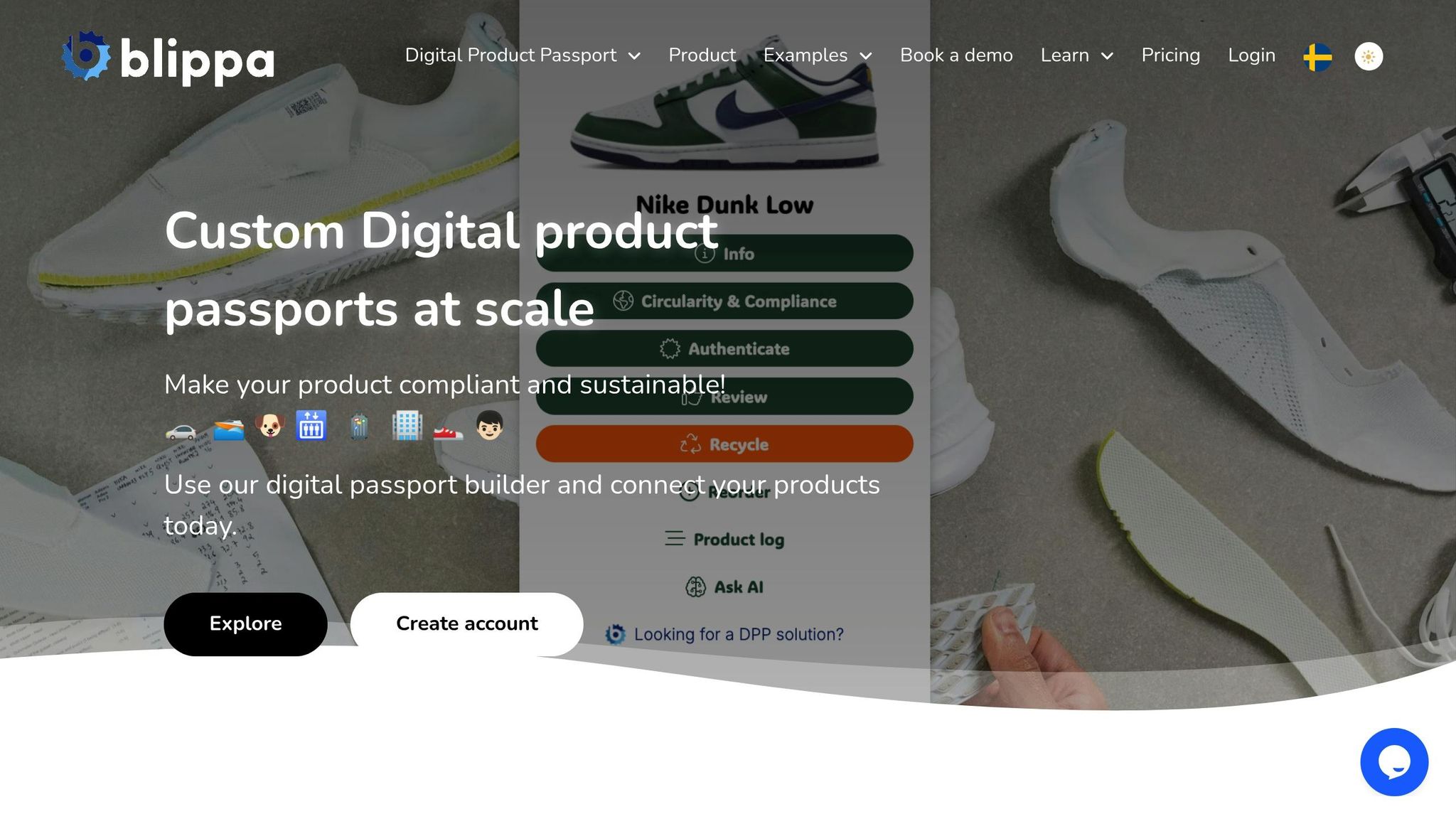
Blippa’s SaaS platform simplifies DPP creation through its no-code features, which include generating digital product identities, creating and managing DPP compliant links, and hosting data in the cloud. Businesses can use pre-designed CIRPASS-compliant templates, eliminating the need for custom development. The platform links each product to data sources containing crucial details like sustainability metrics, material composition, and recycling guidelines. Blippa also supports version control and team collaboration, ensuring data accuracy and consistency as products evolve. Its compatibility with existing enterprise systems makes integration seamless and efficient.
Linking DPPs with ERP and PIM Systems
Modern SaaS platforms designed for DPPs can connect with ERP and PIM systems within hours, following industry standards. These integrations are essential for bridging data gaps, ensuring that details like material origins, carbon footprints, and sustainability data remain up-to-date and verifiable. By automating the flow of information into DPPs, businesses can avoid manual data entry and accommodate dynamic updates, such as maintenance logs or repair instructions, which future regulations are likely to mandate. This capability provides Swedish companies with a strong foundation for compliance and operational efficiency.
Practical Steps for Swedish Companies
Swedish businesses are encouraged to begin with pilot projects in sectors like textiles or electronics, where regulations are expected to take effect first [19,22]. For example, Kappahl, a Swedish retailer, started testing Digital Product Passports in its online collection in early 2024 through the Trace4Value project. This initiative, in collaboration with GS1 Sweden and TrusTrace, evaluates data flow from production to sales. Similarly, the Fibre Traceability Initiative introduced wool garments with traceability data accessible via QR codes in September 2024.
To prepare for ESPR requirements, companies should:
- Identify and address data gaps.
- Adopt GS1 standards for product identification and labelling to ensure compatibility across the supply chain.
- Collaborate with platforms like SwePass for guidance and industry-wide support [19,20,22].
These steps can help Swedish companies navigate the transition to mandatory DPPs while maintaining compliance and operational efficiency.
Governance, Interoperability, and Future Outlook
Governance and Stakeholder Roles
CIRPASS has established a governance framework involving 31 partners, each assigned clear roles – spanning manufacturers, importers, recyclers, and others – for managing product data. To ensure effective data ownership and access, the project introduced two interoperable system architectures: one based on HTTP URIs and another on Decentralised Identifiers (DIDs). In Sweden, organisations like RISE and Chalmers Industriteknik are addressing specific data requirements within their sectors.
To promote collaboration, CIRPASS‑2 is developing a cloud-based DPP Stakeholder Exchange Forum. This platform offers market visibility for solution providers and helps organisations – especially small and medium-sized enterprises (SMEs) – connect with suitable technical partners. It also tackles one of the 28 barriers identified by the project: the difficulty smaller companies face in meeting technical demands for DPP implementation. This governance structure provides a strong foundation for CIRPASS’s ongoing development and alignment with regulations.
Preparing for Future Regulations
With a regulatory framework now in place, Swedish businesses must keep an eye on standardisation initiatives like those led by CEN/CENELEC JTC24. CIRPASS plays a key role in bridging regulatory gaps by offering "User Stories" and practical recommendations, while standardisation efforts focus on ensuring semantic compatibility between systems such as ERP and PIM. Companies should review CIRPASS’s "initial set of information requirements" to familiarise themselves with the mandatory data points expected for industries like textiles, electronics, and batteries. This forward-looking approach helps prepare businesses for the transition to a circular economy.
CIRPASS and the Circular Economy in 2030
By 2030, CIRPASS envisions a shift from wasteful linear economies to a circular economy, supported by Digital Product Passports (DPPs). A 2019 Gartner study highlighted this transformation. After the first phase concluded in March 2024, CIRPASS‑2 expanded to 49 partners, launching 13 pilot projects across key industries – textiles, electronics, tyres, and construction. These pilots aim to validate business models for extending product life, remanufacturing, and recovering materials. By providing detailed data on product composition, DPPs are expected to significantly boost the recovery of valuable materials at the end of a product’s lifecycle.
"DPPs are crucial for enabling the EU’s transition to a circular economy"
Swedish industries are poised to gain considerably from this transition, as DPPs form a key part of sustainability reporting and support the development of Nordic markets. The launch of the CircularData ecosystem hub in June 2025 further highlights the growing emphasis on collaborative, cross-border efforts for digital circularity.
FAQs
What are Digital Product Passports, and how do they contribute to a circular economy?
Digital Product Passports (DPPs) are structured digital records tied to a product through a unique identifier. These records hold detailed information about the product, covering areas like sustainability, circularity, potential for reuse, remanufacturing, and recycling. Importantly, this information is shared and managed securely.
DPPs make product data transparent and accessible, which helps extend product lifespans, use resources more efficiently, and encourage sustainable production practices. They allow consumers to make better-informed decisions, help businesses explore circular economy opportunities, and enable authorities to confirm compliance with environmental rules.
Think of DPPs as a digital "passport" for a product. They improve traceability, support recycling efforts, and play a key role in advancing a resource-efficient circular economy.
How will EU regulations shape the adoption of Digital Product Passports across industries?
The European Union is gearing up to introduce the Ecodesign for Sustainable Products Regulation (ESPR), which will make Digital Product Passports (DPPs) mandatory for industries like electronics, batteries, and textiles starting in 2024. The goal? To establish a standardised framework for product and sustainability data. These digital passports will provide detailed information about a product’s materials, production methods, and options for recycling or repair.
To meet these requirements, businesses will need to implement standardised data models and identification systems that work seamlessly with their existing tools, such as ERP and PIM systems. Supporting this transition is the CIRPASS project, funded by the European Commission. CIRPASS is actively developing prototypes, roadmaps, and data standards to ease the adoption of DPPs. It’s also encouraging the use of no-code solutions to simplify the process, ensuring businesses can integrate these digital passports into their workflows without major disruptions.
By driving transparency and traceability across value chains, these regulations aim to boost sustainability efforts. Companies that adapt early will not only meet compliance but also position themselves for growth as the initiative potentially expands to other industries.
How are Swedish companies involved in the CIRPASS project, and what benefits can they gain?
Swedish organisations, such as RISE and researchers from Chalmers University of Technology, are making a significant impact on the CIRPASS project. Their expertise in sustainability and digital innovation is instrumental in shaping the creation of Digital Product Passports (DPPs) for key industries like textiles, electronics, and batteries.
Through their involvement, Swedish companies gain early access to standardised DPP frameworks. This early adoption supports better product transparency, improved traceability, and alignment with upcoming EU circular economy regulations. By integrating these frameworks, businesses can seamlessly connect with systems like ERP and PIM, recover materials more efficiently, and strengthen second-hand markets, all while reinforcing their circular economy efforts.