
Checklist for Implementing Digital Product Passports
Digital Product Passports (DPPs) are becoming mandatory under the EU’s Ecodesign for Sustainable Products Regulation (ESPR). These digital records link physical products to key data like material composition, repair instructions, and lifecycle impacts, ensuring compliance and enabling circular business models. Swedish businesses must act now to meet these requirements and maintain access to EU markets. Here’s a quick summary of how to get started:
- Assign Responsibilities: Appoint a project lead and create a cross-department team.
- Set Objectives: Prioritize products impacted by ESPR deadlines.
- Audit Data: Identify gaps in existing systems and standardize formats.
- Choose Technology: Use platforms like Blippa for QR codes and no-code DPP design.
- Engage Suppliers: Embed data-sharing requirements into contracts.
- Run Pilots: Test workflows with a small product line before scaling.
This phased approach ensures compliance while improving product transparency and lifecycle management. Start with a pilot project to refine processes and scale up over time.
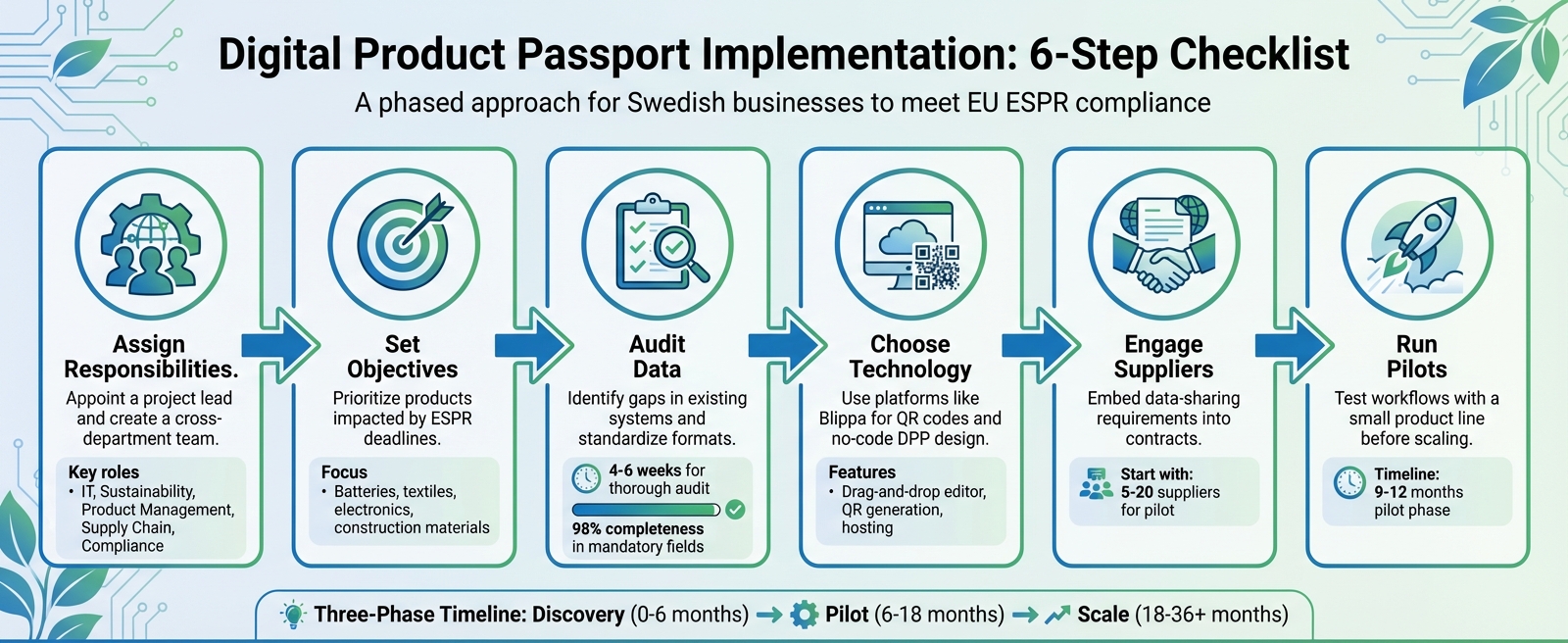
6-Step Implementation Process for Digital Product Passports
The Roadmap to Implementing Digital Product Passports
Governance and Strategy
Laying the groundwork for a successful Digital Product Passport (DPP) implementation starts with strong governance and a clear strategic plan.
Assign Roles and Responsibilities
Begin by appointing a senior DPP owner from areas like sustainability, product management, or compliance. This person should have a clear, executive-approved mandate to oversee the project, coordinate across departments, and report on the Environmental Sustainability Product Regulation (ESPR) milestones. They will serve as the primary point of accountability for the initiative.
Establish a cross-functional steering group that brings together expertise from key departments, such as:
- IT and enterprise architecture: For systems integration and data carriers.
- Sustainability and ESG teams: To address lifecycle assessments and circularity KPIs.
- Product management and R&D: For bills of materials and design-for-circularity efforts.
- Supply chain and procurement: To manage supplier data and include compliance clauses in contracts.
- Quality and regulatory compliance: To ensure adherence to standards like REACH, RoHS, and industry-specific regulations.
- Customer-facing roles: Such as marketing or after-sales, to provide consumer information and repair guidance.
To maintain clarity, define a RACI matrix (Responsible, Accountable, Consulted, Informed) for each DPP task. This should outline responsibilities such as validating material composition data, approving updates, and managing supplier onboarding. Document these roles in internal policies to ensure continuity even with staff changes.
Once roles are defined, the next step is to establish clear objectives and determine the scope of the project.
Set Objectives and Define Scope
Start by mapping your product portfolio against ESPR and DPP timelines. Identify which product categories – such as textiles, consumer electronics, batteries, or construction materials – are likely to face regulation first. Prioritise based on their importance to EU export markets. Use a prioritisation matrix that evaluates factors like:
- Regulatory urgency: Deadlines and compliance risks.
- Revenue and volume in the EU: SEK turnover per segment.
- Data readiness: The availability and organisation of existing data.
- Strategic importance: Key brands or sustainability goals.
Define SMART objectives (Specific, Measurable, Achievable, Relevant, Time-bound). For instance: "By Q4 2026, ensure 100% of batteries sold in the EU have compliant DPPs with at least 98% mandatory-field completeness" or "Reduce manual compliance documentation efforts by 30% by consolidating DPP data into a single platform." Start with manageable, high-volume product families where data is relatively accessible, such as a specific apparel line or a core electronics range. Select one to three pilot use cases – for example, improving recyclability data for textiles, creating end-of-life instructions for electronics, or enhancing transparency for second-hand and leasing programs. Make sure each pilot has clear goals and measurable outcomes.
With objectives in place, create a phased roadmap to guide the project forward.
Build a Phased Roadmap
A phased roadmap tailored to Swedish businesses typically includes three stages: Discovery (0–6 months), Pilot (6–18 months), and Scale (18–36+ months). These phases should align with sector-specific timelines for delegated acts under the ESPR.
- Discovery phase: Conduct a regulatory and data landscape assessment, perform gap analyses, and define your target data model and governance framework. Start with a four- to six-week internal data audit to establish your baseline and outline the project scope.
- Pilot phase: Roll out DPPs for a limited number of product groups. Test supplier data collection processes, select data carriers (e.g., QR codes or NFC tags), and trial tools like PIM systems or no-code platforms such as Blippa for QR generation, hosting, and collaboration.
- Scale-up phase: Expand DPP implementation across all relevant product categories. Integrate DPP processes with ERP, PLM, and CRM systems, and refine workflows for version control, updates, and long-term passport hosting.
Coordinate each phase with EU milestones. For instance, set internal "readiness gates" 12–18 months before the enforcement of delegated acts to allow time for technical adjustments and supplier alignment. Review the roadmap annually to adapt to evolving EU guidance.
Track progress using key performance indicators (KPIs) like data completeness, supplier participation, error rates, time-to-publish DPPs, and sustainability metrics. Regularly review these KPIs within the steering committee to ensure the project stays on course.
Data and Content Preparation
Once your strategic roles and roadmaps are in place, it’s time to focus on preparing your product data. Getting your data ready for Digital Product Passports (DPPs) requires a structured effort to ensure accuracy, completeness, and compliance with EU regulations. This step transforms scattered information across your organisation into organised, verifiable datasets that meet the necessary standards.
Review Your Product Data
Start by identifying all your current data sources. These might include:
- ERP systems (e.g., commercial details, logistics, warranty information)
- PLM platforms (e.g., design files, bills of materials, manufacturing processes)
- PIM systems (e.g., marketing content, usage instructions, care guidelines)
- Spreadsheets, local databases, and supplier portals
Next, map your data fields against the mandatory DPP requirements and pinpoint any gaps. For example, you might discover that while your PLM system contains material composition data, it lacks the substance-level detail needed for REACH SVHC reporting. Or, you may find that energy consumption figures are recorded in kWh but aren’t tied to specific product identifiers.
To ensure consistency, standardise your units. Use metric measurements (e.g., kg, g, mm, cm), °C for temperature, European number formats (e.g., 1 234,56), and display currency in SEK. Product identifiers such as SKU, GTIN, or serial numbers must be consistent across systems, linking physical products to their digital passports using QR codes or NFC tags.
A thorough data audit typically takes 4–6 weeks. Set clear acceptance thresholds, such as aiming for at least 98% completeness in mandatory fields and keeping duplicate identifiers below 1%.
Verify Data Traceability and Documentation
One of the biggest challenges is ensuring traceability throughout the product lifecycle. This includes documenting material and component origins, supplier details, composition data, and regulated substance flags. Manufacturing data should cover production locations, process parameters, and energy mix information when available. Distribution and logistics data, such as transport modes and distances, contribute to carbon footprint calculations, while use-phase information should address spare parts availability, repair instructions, and warranty conditions.
To improve traceability, embed data requirements into supplier contracts and RFQs. Request full material disclosure, including REACH SVHC and RoHS compliance, and use structured data exchange formats like IPC-1752A or IEC 62474 for material and chemical information.
Store key documents – such as certificates, safety datasheets, test reports, eco-labels, and LCA summaries – in a central repository. Tag them by product identifier, supplier, and document type. Each DPP data field that relies on evidence should include a reference to the underlying proof (e.g., a URI or document ID) to simplify audits.
For Swedish stakeholders, it’s wise to store both Swedish and English versions of critical certificates, especially if exporting to other EU markets. Define document retention rules that align with product lifetimes and EU requirements, and maintain an audit trail detailing who uploaded, reviewed, and approved each document.
Set Up Data Quality Controls
Implementing strong quality controls is essential to prevent errors and keep your DPPs compliant over time. Define mandatory fields for each product group based on EU delegated acts, such as material composition, recyclability details, and SVHC presence. Configure your systems to block records from being published without these critical details.
Validation rules should cover numeric ranges, logical consistency, and ISO-compliant country codes. Use controlled vocabularies for materials, processes, and end-of-life options. Establish workflows ensuring that designated data owners – typically from quality, sustainability, or product management teams – review and approve all new or updated DPP data. For high-risk information, like chemical content or safety-critical specifications, employ a four-eyes review process.
Version control is crucial. Log all changes with timestamps, user IDs, and reasons for edits to maintain a traceable history. Regular data audits, such as quarterly reviews, can help you compare DPP records against source systems and physical products, addressing any systemic issues early.
No-code platforms like Blippa can simplify this process by enforcing schemas, integrating via APIs, and automatically updating QR codes and passport pages. This ensures that each product is linked to the latest compliant passport while maintaining full traceability for regulators and partners.
Key performance indicators (KPIs) for data quality might include:
- DPP data completeness per product family
- Number of data quality incidents per quarter
- Lead time from product change to DPP update
- Percentage of supplier data delivered on time in standard formats
- Compliance metrics, such as timely adoption of new SVHC lists
Review these KPIs regularly alongside other compliance and sustainability metrics to treat DPP data as an ongoing priority rather than a one-time task.
With strong data controls in place, your DPPs will be ready to integrate seamlessly with technological tools and supplier systems in the next phase.
Technology and Integration
Once your data is prepped and quality checks are in place, it’s time to focus on the technology that powers your Digital Product Passports (DPPs). This step involves linking your current IT systems, selecting suitable data carriers, and ensuring security and compliance throughout the lifecycle of the passports.
Review IT Infrastructure and Data Carriers
Start by identifying all systems that store product data – such as ERP, PLM, PIM, CRM, service platforms, and e-commerce systems. Check if these systems support automated data sharing, like through APIs, to allow for the continuous and centralised generation of DPPs. Confirm that your infrastructure can handle long-term storage for the product’s entire lifecycle and manage version control for situations like repairs, resale, or end-of-life processes.
Ensure your systems align with Swedish standards for currency, units, and data formats. To streamline operations, consider an integration layer – either through a PIM platform or a dedicated DPP hub – that centralises data and automates passport creation.
When it comes to data carriers, your choice depends on the product type, usage environment, and durability needs. For consumer goods like clothing, furniture, or electronics, QR codes (either printed or laser-marked) are often the most practical and cost-effective solution, as they’re easily scanned by smartphones in shops, second-hand stores, or recycling centres. On the other hand, products exposed to harsh Nordic conditions – such as outdoor machinery or components facing moisture and temperature extremes – may require more durable options like NFC tags or RFID labels. High-value or safety-critical items, like EV batteries, might benefit from a combination of QR codes for consumer use and NFC/RFID for industrial logistics. Whichever carrier you choose, ensure it complies with ISO/IEC and EU standards and remains readable throughout the product’s lifecycle, including reuse and remanufacturing phases.
Once your infrastructure is ready, you can simplify DPP creation and management with modern tools.
Use No-Code Tools for Efficiency
No-code platforms can speed up DPP implementation by enabling non-technical teams to design and manage passport pages without heavy coding. Tools like Blippa offer drag-and-drop editors, pre-built templates, and configurable data fields, making it easier for teams in sustainability, product management, and compliance to collaborate on DPP content. These platforms also include built-in GS1 Digital link generators as well as QR code editors, which simplify the process of assigning unique identifiers and embedding them on products and packaging at scale. Integrated hosting ensures DPPs remain accessible throughout the product’s lifecycle.
With no-code tools, business teams can quickly update DPPs, ensuring consistent branding and multilingual support while reducing manual data entry errors. These platforms complement existing IT setups by pulling structured data directly from systems like ERP, PIM, or PLM, eliminating redundant work. When evaluating these tools, look for features like custom attributes, multilingual content, lifecycle tracking, and the ability to support large product catalogues common in Nordic industries.
Blippa, for example, provides a robust no-code editor, pre-designed DPP-compliant templates, and tools for QR code creation. Its hosting capabilities ensure real-time updates across all passports. The platform also integrates with systems tailored to Swedish market needs, offering seamless data exchange and automation. By late 2025, Blippa plans to include AI-powered features like an Image Generator and an editor assistant, further enhancing its functionality.
Before committing, assess the total cost of ownership, including licences, implementation, and training, by testing the platform with realistic scenarios.
Implement Security and Standards Compliance
With the technology in place, the next focus is securing data access and ensuring compliance with relevant standards. Start by implementing robust access controls and encryption to protect DPP data.
For web and API access, use HTTPS/TLS encryption to secure traffic. Authentication protocols like OAuth 2.0 or OpenID Connect should be used for partner and service access. Role-based access control (RBAC) within your DPP platform ensures that only authorised users can view or modify sensitive data. Public DPP views should only display non-sensitive information, such as product details, repair guides, and sustainability metrics, while confidential data – like supplier compositions or test reports – should remain restricted to authenticated users.
Separate public and restricted API endpoints, and implement access logging and monitoring to bolster security. Encrypt data stored in databases and backups, and regularly apply security patches and conduct vulnerability scans to prevent breaches. These measures should be supported by clear access policies and regular staff training, especially since DPPs will often be accessed publicly via QR codes in stores, recycling centres, and repair facilities across Sweden.
For GDPR compliance, focus on minimising personal data in DPPs. When personal data is necessary – such as in warranty or leasing scenarios – store it in separate systems and reference it in the DPP using tokens or IDs instead of direct identifiers. Conduct Data Protection Impact Assessments (DPIAs) for implementations involving personal data and document the lawful basis for processing. Additionally, ensure data hosting remains within the EU, provide clear privacy notices via the DPP interface, and secure processor agreements that meet GDPR Article 28 requirements.
Lastly, ensure your product identifiers meet EU DPP registry standards. Use globally recognised formats like ISO/IEC 15459 or GS1 identifiers, and set up a central service to generate and manage these identifiers. This ensures traceability across ownership cycles and prevents issues like identifier reuse. To maintain long-term reliability, plan for stable hosting with redundancy, regular backups, and a strategy for evolving technologies. This guarantees that DPP URLs and resolver services remain functional throughout the product’s lifecycle, even during second-hand use or repairs. This kind of continuity ensures that every product reflects accurate and up-to-date compliance information over time.
Supplier and Partner Collaboration
Suppliers play a critical role in implementing your Digital Product Passport (DPP) strategy. They hold essential data like material details, carbon footprint metrics, and lifecycle information. Begin by identifying which suppliers possess this critical information – such as material composition, recycled content, and certifications – and evaluate their ability to provide structured data. This step lays the groundwork for clear communication and collaboration with your supplier network.
Communicate DPP Requirements
To ensure suppliers understand their role, provide detailed written specifications that outline the required data, its purpose, and how it will be used. Identify which DPP fields rely on supplier input, such as material composition, hazardous substances, repair instructions, and end-of-life guidance. Tailor the requirements based on supplier tiers: Tier-1 suppliers typically need to provide detailed product- and component-level data, while Tier-2 and Tier-3 suppliers can focus on specific data points required by Tier-1.
To streamline the process, supply standardised templates in formats like Excel, CSV, or API-ready files that align with ESPR delegated-act fields. These templates should include fixed column names, mandatory/optional flags, data types, and unit conventions. Support suppliers by hosting bilingual webinars, sharing handbooks with FAQs, and providing visual aids that demonstrate how DPP data integrates into the product lifecycle. This is especially helpful for suppliers with limited digital capabilities.
Once these requirements are established, embed them directly into your procurement processes.
Add DPP Requirements to Procurement
Incorporate DPP obligations into RFQs, framework agreements, and purchase terms. Make the submission of accurate, structured DPP data a mandatory condition for doing business. Contracts should clearly specify which datasets are required (e.g., full material disclosure, certificates, carbon data), outline the responsibility for keeping this data updated over the product’s lifecycle, and define consequences for non-compliance, such as payment delays, penalties, or removal from the approved supplier list.
To ensure readiness, include DPP clauses in onboarding checklists, requiring suppliers to submit test data before full approval. This step ensures alignment with ESPR Article 10, which governs controlled-access data sharing.
Start small by selecting a pilot product with a manageable group of 5–20 suppliers to test the DPP process end-to-end. Informatica suggests a 13–18 month roadmap: months 1–3 focus on identifying key suppliers and assessing their technical capacity, months 4–8 on onboarding critical Tier-1 suppliers, and months 13–18 on scaling to the broader supplier network.
Monitor and Support Supplier Readiness
Begin with a supplier capability assessment to evaluate their understanding of DPP/ESPR requirements, ability to provide structured data, and existing documentation (e.g., certifications, test reports). Segment suppliers into categories like "advanced" (API-ready with full traceability), "developing" (structured data but manual processes), and "basic" (spreadsheet-based with partial data). Offer tailored support: advanced suppliers can connect via APIs or system integrations, while less mature suppliers might benefit from simpler tools like web portals, shared forms with validation features, or bulk CSV upload options.
Track progress using key metrics such as the percentage of suppliers providing complete data, the share of SKUs with verified passports, average data delivery times, and error rates in data validation. Review these indicators quarterly with strategic suppliers and monthly during pilot or early rollout phases. Use dashboards or scorecards integrated into supplier performance reviews to monitor progress. Regular touchpoints – like quarterly review meetings or virtual check-ins – can address DPP performance, regulatory updates, and any audit issues. Establish clear workflows for managing changes, ensuring suppliers update DPP data promptly when materials, components, or processes are modified.
Platforms like Blippa simplify supplier collaboration by offering a centralised environment for designing DPP data models, managing QR codes, hosting passport content, and inviting suppliers to contribute data through user-friendly, no-code interfaces. These tools reduce IT complexity for smaller partners. Collaboration features also allow suppliers, logistics providers, and recyclers to update relevant passport sections throughout the product lifecycle, maintaining a single source of truth.
Pilot, Rollout, and Continuous Improvement
With a solid foundation in governance, data management, technology, and supplier coordination, the next step is to put the Digital Product Passport (DPP) workflow to the test. A pilot project is the perfect way to validate the process, uncover any gaps, and build trust within your organisation before moving to a full-scale rollout.
Run a Pilot Project
Begin by choosing one or two product lines that are already – or will soon be – subject to the EU’s Ecodesign for Sustainable Products Regulation (ESPR). Good starting points might include batteries or textiles. Pick products with moderate complexity and a manageable supplier network (around 5–20 partners). This keeps the scope realistic while allowing you to test data flows effectively without overloading your team. A typical pilot phase spans 9–12 months and includes discovery, infrastructure setup, and validation.
Define clear success criteria for your pilot. Ensure all required data fields are complete, accurate, and compliant. Track key metrics such as:
- Percentage of required fields populated
- Error rates after validation
- Time taken to create or update a passport
- Reduction in manual processes
For sustainability, focus on gathering lifecycle data like recycled content, carbon footprint (measured in kg CO₂e), and material sourcing details across the pilot products.
Test QR code functionality across Swedish and EU markets. A tool like Blippa’s no-code platform can simplify this process by allowing you to configure layouts, manage version control, and support multiple languages (e.g., Swedish and English). Collect usability feedback to fine-tune your DPP design.
Once the pilot is validated, you’ll be ready to scale up the solution seamlessly.
Scale Your Implementation
Using insights from the pilot and refined standard operating procedures (SOPs), you can expand your DPP rollout. Document key processes, including:
- Product onboarding (data formats and units)
- Supplier data collection and verification
- Assigning and printing unique identifiers and QR codes
- Lifecycle updates (repairs, refurbishments, recycling)
- Compliance checks with ESPR and product-specific delegated acts
Identify which systems (like PIM, PLM, or ERP) will serve as the "source of truth" and detail how they integrate with your DPP platform. If your company exports to the EU, include routines for managing multiple languages and market-specific legal requirements while keeping core data consistent. Train your employees on these SOPs and integrate them into existing quality and environmental management systems, such as ISO 9001 or ISO 14001.
Roll out the DPP in stages, focusing on product categories or brands with earlier regulatory deadlines or higher revenue potential in Sweden and the EU. Use the templates and data models refined during the pilot to generate additional DPPs through bulk imports (e.g., CSV uploads) or API integrations with ERP and PIM systems. For suppliers, start with Tier-1 partners and gradually expand to Tier-2 and Tier-3 to ensure full traceability. Provide clear data templates and use supplier portals to facilitate direct data entry. For international suppliers, include contractual clauses that require DPP-related data sharing and specify update timelines.
Stay aligned with EU and ESPR regulations by assigning a regulatory owner or forming a committee to monitor legislative changes. Use a change-management process to update your DPP or PIM systems whenever new data fields or access rules are introduced. Conduct regular internal audits – at least annually – to ensure compliance and accessibility throughout the product lifecycle.
Track Performance and Sustainability Metrics
Set up performance metrics to monitor DPP coverage, time and cost efficiency for passport creation or updates, error rates during validation, and system uptime or QR code scan success rates. Sustainability metrics should include recycled content, carbon footprint (kg CO₂e), hazardous substance elimination, and end-of-life outcomes. Over time, link these metrics to Swedish and EU climate goals, such as reducing CO₂e per SEK of revenue or increasing the use of circular materials. Additionally, track compliance (e.g., percentage of products meeting ESPR/DPP standards) and usage metrics like the number of scans by end-users.
Create dashboards within your BI or DPP platform to consolidate data from PIM, ERP, and DPP systems via APIs. These dashboards should display key indicators such as DPP coverage, data completeness, supplier response times, and environmental attributes. Organise the information by product category and market. For sustainability, visualise metrics like emissions, recycled content, and hazardous substances in formats that are familiar to Swedish stakeholders. Schedule regular reviews – monthly operational meetings and quarterly management sessions – to analyse trends and decide on actions. Align these dashboards with Sweden-specific reporting requirements, such as corporate sustainability and CSRD disclosures.
Continuous improvement depends on structured feedback, regular audits, and ongoing optimisation. Establish feedback loops with internal teams, suppliers, retailers, service partners, and customers to assess data quality and usability – for example, how clear and accessible sustainability information is for Swedish consumers. Implement systems that flag DPPs for review whenever there are changes in materials, suppliers, or regulated substances.
Companies using Blippa’s DPP platform have reported impressive efficiency gains, such as 50% faster access to critical information, saving 200 hours in 2022, a 17% boost in customer spending, and five-fold reductions in time spent on paperwork. These results can serve as benchmarks as you continue refining your DPP processes.
Conclusion
Key Lessons from the Checklist
Implementing Digital Product Passports (DPPs) successfully depends on four critical areas: governance, data readiness, technology, and collaboration. Swedish companies that establish a cross-functional steering group, appoint a dedicated DPP owner, and define clear decision-making rights can ensure a smoother and more focused implementation process. Viewing DPPs as a strategic change initiative, rather than just a compliance requirement, can bring real benefits. These include reducing product returns, improving warranty management, and enhancing sustainability branding – both within Sweden and across the EU.
Strong data audits and seamless system integration are essential for creating audit-ready DPPs. Equally important is fostering close collaboration with suppliers. By clearly defining data requirements, setting deadlines, and embedding these obligations into procurement processes, companies can address common challenges effectively. These insights provide a clear roadmap for taking immediate, actionable steps.
Next Steps for Swedish Businesses
To turn these insights into action, Swedish companies can start by focusing on a pilot project. Choose one product line with an upcoming regulatory deadline – such as batteries or textiles – engage 5–20 suppliers, and establish measurable goals. These could include ensuring data completeness, making passports readily available, and keeping process costs under control. A 9–12 month pilot allows businesses to test workflows, refine templates, and address any issues before scaling up.
For small and medium-sized enterprises (SMEs) or mid-sized firms looking to move quickly without large IT investments, tools like Blippa can simplify the process. Blippa’s no-code platform offers features like a drag-and-drop editor, QR code generation, customisable templates, hosting, version control, and collaboration tools. This enables non-technical teams to create and manage DPPs efficiently while integrating with existing systems.
To get started, conduct a regulatory and portfolio review, assess data readiness for one or two priority product lines, and appoint a DPP owner to lead the initiative. Taking a phased, structured approach will not only help Swedish businesses meet compliance deadlines but also enhance transparency and position them for long-term success in a more circular economy.
FAQs
What are the key steps to begin a Digital Product Passport project?
The first step in launching a Digital Product Passport (DPP) project is to set clear objectives and determine which product data is essential to include. Platforms like Blippa, which require no coding expertise, can simplify the process of creating and managing your DPPs. These tools often feature QR code generators and customisable templates, making it easy to digitise your products and ensure they are accessible.
It’s also crucial to work closely with stakeholders to gather all necessary data and ensure it aligns with local Swedish standards. Pay attention to regulatory compliance and think about incorporating traceability and sustainability into your workflows. By starting with well-defined goals and leveraging the right tools, you’ll create a solid foundation for your DPP project.
What steps can Swedish businesses take to ensure their data complies with EU regulations for Digital Product Passports?
To align with EU regulations such as GDPR, Swedish businesses need to implement solid data governance strategies. This means getting clear and informed consent before collecting data, ensuring data remains accurate, and being upfront about how it’s processed and shared. Regularly conducting audits, using secure storage systems, and establishing clear rules for accessing and sharing data are critical steps in staying compliant.
Platforms like Blippa can make compliance easier by providing secure, easy-to-use tools for managing Digital Product Passports. These solutions promote transparent data management while helping businesses meet regulatory standards efficiently.
What are the best tools for effectively managing Digital Product Passports?
To handle Digital Product Passports efficiently, a no-code platform like Blippa can be a game-changer. Blippa comes packed with practical tools, including a cloud-based editor, a QR code generator, pre-designed templates, and built-in hosting. These features make it easier to create, update, and expand your Digital Product Passports without needing advanced technical skills.
Blippa also supports third-party integrations and offers features like collaboration tools and version control. This flexibility makes it suitable for a range of industries, such as e-mobility, real estate, and fashion. With these tools, you can make your products digital, traceable, and aligned with environmental and sustainability objectives.