
Priority DPP requirements going into 2026
Digital Product Passports (DPPs) are becoming mandatory for products sold in the EU starting 2026. These passports store key details about a product’s lifecycle, including its origin, materials, compliance, and recycling instructions. With the Ecodesign for Sustainable Products Regulation (ESPR) in effect since July 2024, businesses must act now to prepare for compliance. Swedish industries like textiles, electronics, and batteries are among the first impacted.
Key Takeaways:
- What’s Required: Unique product IDs, material composition, repairability data, and more.
- Timeline: ESPR is active, with product-specific rules rolling out from 2026 to 2030.
- Swedish Focus: Compliance ensures EU market access, with agencies like Kemikalieinspektionen overseeing enforcement.
- Steps to Prepare: Audit product data, digitize records, and integrate systems like ERP and PIM.
For Swedish companies, early compliance isn’t just about meeting regulations – it’s also about maintaining competitiveness in the EU market. Tools like Blippa simplify DPP creation with no-code solutions, making it easier to meet these new requirements without major technical overhauls. The time to prepare is now.
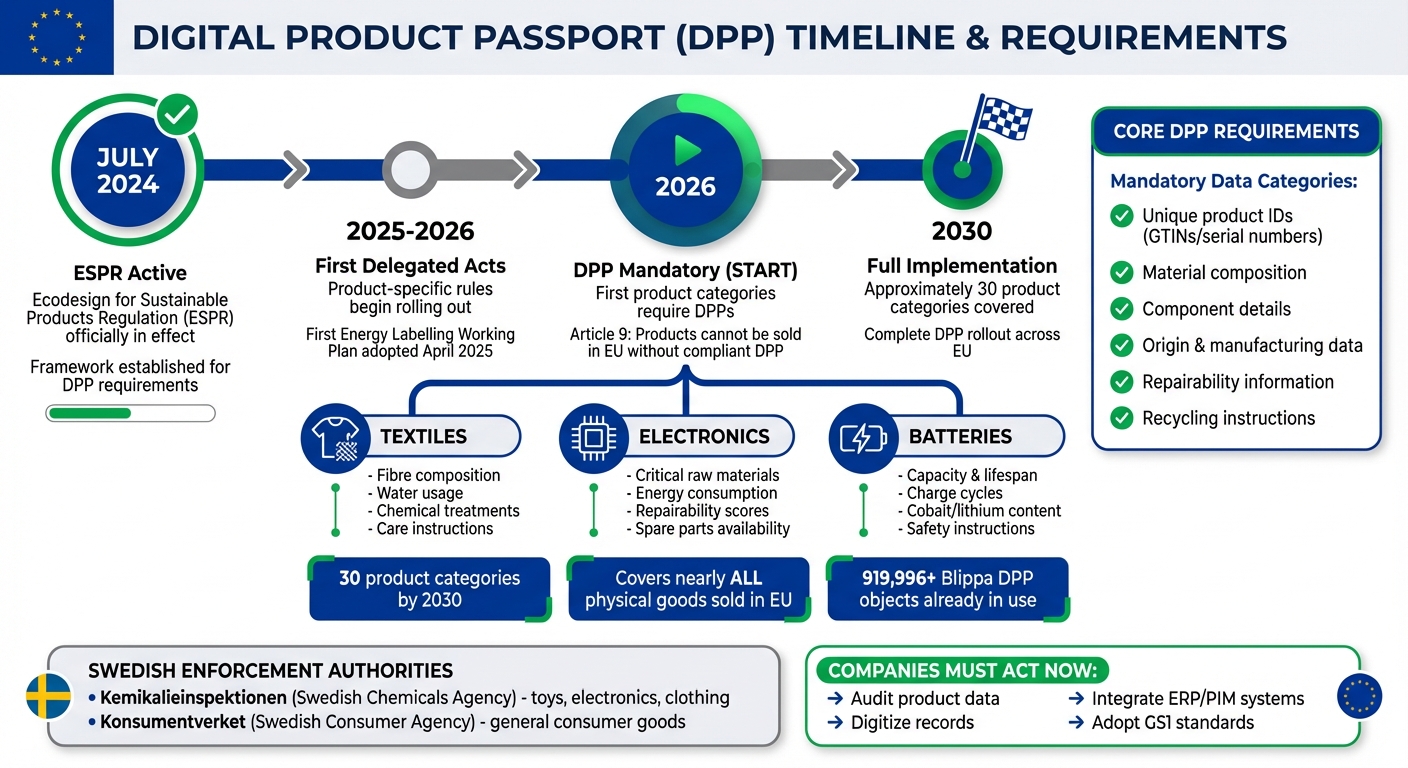
Digital Product Passport Implementation Timeline 2024-2030 for Swedish Companies
Regulatory Framework for 2026
ESPR and Delegated Acts Explained
The Ecodesign for Sustainable Products Regulation (ESPR), proposed in March 2022, officially adopted in April 2024, and effective since July 2024, lays the groundwork for Digital Product Passports (DPPs). This regulation replaces and expands upon the earlier Ecodesign Directive.
Rather than setting direct product requirements, the ESPR acts as a framework, empowering the European Commission to establish detailed obligations through delegated acts. These acts will determine which product categories require DPPs, specify the data to be included, and outline the technical implementation details. As of May 2025, no delegated acts have been issued. However, the first Energy Labelling Working Plan, adopted on 1 April, signals that product-specific rules are on the horizon.
Under Article 9, products can only be sold in the EU market if a DPP is available and complies with the relevant delegated acts. The ESPR applies to nearly all physical goods sold or used in the EU, including components and intermediate products. Exceptions include items like food, feed, medicinal products, living plants and animals, products of human origin, and certain vehicles. The rollout for DPPs will span from 2026 to approximately 2030, ultimately covering around 30 product categories.
"The European Commission has recently approved the Ecodesign for Sustainable Product Regulation (ESPR), a forward-thinking piece of legislation that puts Digital Product Passports at the heart of achieving the objectives of the European Green Deal." – GS1 Sweden
These regulatory developments are set to reshape how Swedish industries operate.
Impact on Swedish Industries
Swedish businesses in sectors like textiles, electronics, and batteries will be among the first to meet DPP requirements. These industries are prioritised due to their environmental impact and the EU’s focus on promoting circular economies. Meeting these requirements is not just about compliance – it also ensures continued access to the EU market. For companies, early compliance can be a strategic advantage, strengthening their position with environmentally conscious customers.
Enforcement Timeline and Authorities
In Sweden, enforcement of DPP compliance will fall under established regulatory frameworks. The Swedish Chemicals Agency (Kemikalieinspektionen) will play a central role, as it already oversees compliance for chemical products and articles such as toys, electronics, and clothing – categories likely to require DPPs. The Swedish Consumer Agency (Konsumentverket) will also contribute by monitoring compliance for general consumer goods.
Key deadlines are approaching fast. While the ESPR has been in force since July 2024, the first product-specific delegated acts will come into effect in 2026. Companies must keep a close eye on the Official Journal for updates on these acts and evaluate which of their products will need to comply. Preparing now – by auditing product data, identifying any gaps, and digitising required information – is critical.
"Our objective is to provide GS1 users with the best conditions to meet ESPR with GS1 standards. The work within CEN/Cenelec will establish the technical conditions for Digital Product Passports." – Johan Dahlgren, Head of Standards at GS1 Sweden
Swedish companies must act quickly, working closely with their suppliers to ensure transparency throughout the supply chain becomes a cornerstone of compliance efforts.
Required Data and Interoperability Standards
Mandatory Data Categories
Every Digital Product Passport (DPP) must include essential information as outlined by the ESPR. This includes product identification, origin, material composition, and component details. At its core, product identification and origin require unique identifiers like GTINs or serial numbers to ensure traceability. Additional details such as manufacturer or importer information, manufacturing date and location, batch number, product name, model, catalogue number, country of origin, and product classification are also mandatory.
The second key category is material composition and components. DPPs must outline the product’s composition, specifying materials, components, and their respective proportions. This includes details on the origin of raw materials and the identification of any restricted hazardous substances, such as lead, asbestos, phthalates, or halogens.
Industry-Specific Data Requirements
Different industries have additional data requirements tailored to their specific needs:
- Textiles: Fibre composition, water usage, chemical treatments, and care instructions.
- Electronics: Critical raw materials, energy consumption, repairability scores, and availability of spare parts.
- Batteries: Capacity, lifespan, charge cycles, cobalt and lithium content, and safety instructions.
These tailored requirements ensure detailed and relevant data is captured, paving the way for effective standardisation and data exchange.
Data Standards and Interoperability
For seamless data sharing, harmonised technical frameworks are indispensable. The European Interoperability Framework (EIF) provides a comprehensive model that addresses legal, organisational, semantic, and technical layers of DPP design. A key element of this framework is semantic interoperability, which ensures consistent data interpretation across systems through the use of shared vocabularies, ontologies, and models. Machine-readable schemas like RDF Schema and RDF Turtle format further streamline information exchange.
The Product Circularity DataSheet (PCDS) initiative is working on a global open-source standard for sharing data about chemical composition, hazards, and recycled materials throughout the supply chain. Additionally, API-driven integration and data formats like XML or JSON enable real-time, seamless data exchange between DPPs and systems like ERP and PIM.
In Sweden, companies are expected to adopt these international open standards for data identification, exchange, and storage. Compliance with ISO/IEC 15459 standards is essential, as it ensures global recognition and traceability, enabling products to be seamlessly tracked across borders and systems.
System Integration and Traceability
Connecting ERP and PIM Systems to DPPs
To implement Digital Product Passports (DPPs) effectively, Swedish businesses need to ensure their existing enterprise systems integrate smoothly with the digital passport infrastructure. Product Information Management (PIM) systems play a crucial role here, acting as the central repository for consolidating product data. This ensures consistent and automated updates throughout the product’s lifecycle, reducing manual errors and improving efficiency.
On the other hand, Enterprise Resource Planning (ERP) systems bring real-time operational data into the mix. By using traceability software, ERP data can be standardised and prepared for near-automated submissions to DPPs. This setup essentially creates a digital twin for each product, tracking its journey from production to disposal. Along the way, it captures vital details like materials used, compliance documentation, maintenance records, and end-of-life instructions. This level of integration is a critical step toward meeting the technical requirements set for 2026.
Technical Requirements for 2026
Looking ahead to 2026, Swedish companies must prepare their infrastructure to support open and structured data formats. To achieve this, businesses should adopt API-driven architectures that enable real-time data exchange. Scalable systems for managing unique product identifiers, such as GTINs or serial numbers, are also essential to ensure efficient product tracking.
Maintaining data quality throughout the product lifecycle is another key priority. Companies should invest in data governance tools capable of keeping information complete, accurate, and up to date. Systems that can handle structured formats like XML or JSON are highly recommended, as they allow seamless communication between PIM, ERP, and DPP platforms.
Supply Chain Traceability
Once internal systems are integrated, traceability efforts must extend across the entire supply chain. DPPs are designed to connect with broader EU digital frameworks, including customs and regulatory systems. For this to work, upstream suppliers need to provide standardised data that integrates seamlessly into manufacturers’ systems. This, in turn, ensures downstream stakeholders – such as repair technicians or recyclers – can access the necessary passport information for maintenance, repair, and recycling tasks.
For Swedish businesses, coordinating data collection across international supply chains remains a significant challenge. Every component must be properly documented to achieve end-to-end visibility. This approach supports full lifecycle traceability, covering everything from raw material extraction to manufacturing, distribution, usage, and final recycling or disposal. Establishing clear data-sharing protocols is essential to ensure accurate and timely information flows throughout the value chain.
sbb-itb-256b3ff
Navigating the Digital Product Passport: What are Your Compliance Obligations? | Compliance & Risks
How Blippa Supports No-Code DPP Implementation
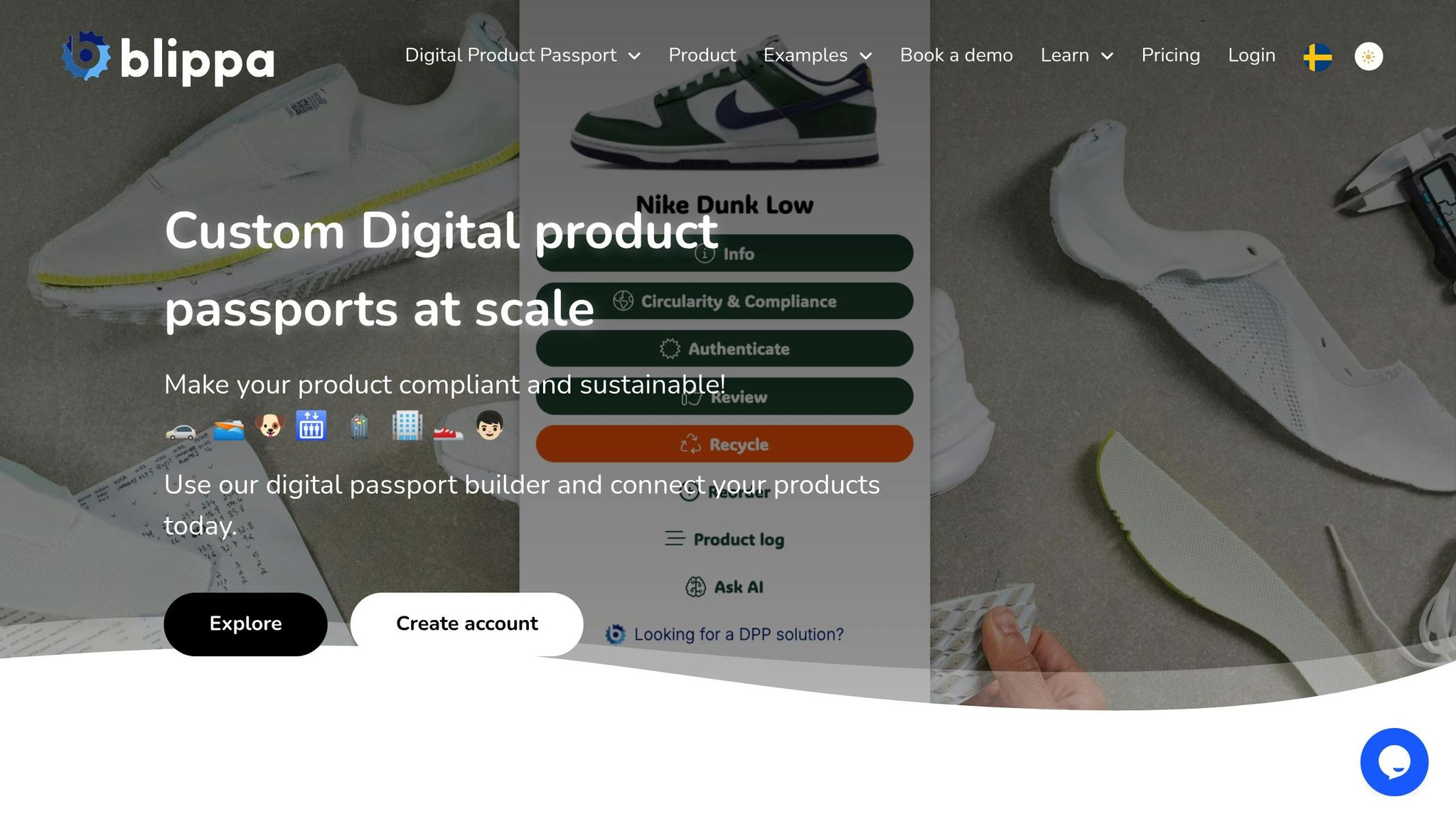
Blippa builds on the regulatory and technical groundwork to simplify Digital Product Passport (DPP) compliance with its no-code platform approach.
Blippa Features for DPP Compliance
Blippa is a no-code platform designed to create and manage DPPs on a large scale. With over 919,996 Blippa objects currently in use, the platform has proven its ability to handle extensive DPP deployments across various industries. Swedish businesses can use Blippa’s no-code editor to meet 2026 compliance requirements without the need for coding expertise.
The platform includes a page and QR design editor, enabling the creation of scannable codes for product identification, which aligns with the ESPR’s guidelines for accessible digital carriers. Pre-built templates and functionalities provide businesses with a head start, particularly in sectors like textiles, electronics, and batteries. Additionally, Blippa’s DPPs function as fully dynamic websites with role-based access, displaying tailored information based on the viewer’s role – whether an anonymous user, product owner, or service technician.
Blippa also offers built-in cloud hosting, ensuring instant synchronization for content updates – essentially putting DPP management on autopilot. In July 2025, the platform introduced GS1 label file generation for factories, aiding the shift to standardized GS1 Digital Link QR codes. By November 2025, Blippa had integrated AI tools into its editor, automating content creation and image generation to further simplify the process of populating DPPs with necessary details.
Benefits for Swedish Companies
Swedish businesses stand to gain from Blippa’s practical tools. Its multi-lingual forms and dynamic translation options make it easier to localize DPPs for the Swedish market while staying compliant with EU regulations. Leading brands like Electrolux (appliances), Nudie (apparel), and Lindex (apparel) already test Blippa for their DPPs, with projects also being developed for several multinational companies within (furniture) and (travel goods).
Blippa’s API access and third-party integration capabilities also allow companies to link the platform with existing ERP and PIM systems seamlessly. This ensures smooth data flow without requiring major changes to current infrastructure. With 24,997 hours of development invested in the platform and an 86% client satisfaction rate, case studies highlight notable benefits such as 50% faster access to critical information, 200 hours saved, and a fivefold reduction in paperwork.
Mapping Blippa Features to DPP Requirements
The table below outlines how Blippa’s features align with mandatory DPP requirements, demonstrating its ability to meet technical needs effectively.
| DPP Requirement | Blippa Feature | Implementation Benefit |
|---|---|---|
| Unique Product Identification | QR code generator with GS1 Digital Link support | Automated creation of compliant product identifiers accessible via QR codes |
| Structured Data Standards | No-code editor with open data format support | Build DPPs using XML/JSON-compatible structures without the need for technical skills |
| Supply Chain Traceability | API access and third-party integrations | Real-time data exchange across the value chain by connecting to existing ERP/PIM systems |
| Dynamic Content Updates | Cloud hosting with instant updates | Keep product information current throughout its lifecycle without manual effort |
| Role-Based Access Control | Dynamic content display by user role | Protect sensitive business data while ensuring transparency for regulators and consumers |
| Multi-Market Compliance | Multi-lingual forms and translation tools | Localize DPPs for Swedish markets while ensuring consistency across the EU |
Conclusion
Swedish companies are on the clock. With DPP requirements for batteries, textiles, and electronics rolling out between 2026 and 2030, there’s no time to waste. Meeting these regulations requires well-structured data – think unique identifiers, standard formats, and smooth integration with ERP and PIM systems. Without this foundation, businesses risk supply chain chaos and hefty penalties.
Enter Blippa. This no-code platform eliminates the technical hurdles of DPP adoption, offering Swedish companies an easy way to align with both regulatory and interoperability standards. By streamlining the integration of digital product data, Blippa ensures businesses can meet compliance demands without unnecessary headaches.
The ESPR is already in motion, with product-specific standards expected as early as 2025–2026. Companies that procrastinate will face a scramble to catch up, while those who act now will have the advantage of refining their processes, training their teams, and building the necessary data infrastructure.
With the tools in place and deadlines fast approaching, now’s the moment to kick-start your DPP strategy. Blippa makes compliance accessible, paving the way for Swedish businesses to not only meet regulatory demands but also unlock the benefits of improved digital product transparency. The choice is clear: start today and stay ahead of the curve.
FAQs
What are the essential features of a Digital Product Passport by 2026?
A Digital Product Passport (DPP) needs to cover several essential aspects to align with the 2026 requirements. These include product identification – such as details on origin, material composition, and components – alongside information about its environmental impact, including carbon footprint and sustainability metrics. It should also outline durability and repairability specifications and provide clear end-of-life guidance for recycling or disposal. Ensuring compliance with relevant regulatory and certification standards is another key requirement.
To make adoption easier, DPPs should enable data integration with systems like ERP or PIM and offer intuitive, no-code platforms. This approach facilitates smooth implementation across industries like textiles, electronics, and batteries, supporting traceability and sustainability efforts aligned with Swedish and broader EU objectives.
What steps should Swedish companies take to comply with ESPR requirements by 2026?
To meet ESPR requirements by 2026, companies in Sweden should prioritise setting up traceability systems that span the entire product lifecycle. This means combining data management tools with existing ERP and PIM systems to simplify workflows and maintain accurate reporting.
Adopting no-code solutions can make it easier to manage and update Digital Product Passports (DPPs), streamlining the compliance process. Additionally, aligning sustainability objectives with regulatory requirements and conducting regular supply chain assessments to spot and address risks is essential. Taking these proactive steps not only ensures compliance but also supports the long-term resilience of your business.
How does Blippa make it easier to implement Digital Product Passports (DPPs)?
Blippa takes the hassle out of implementing Digital Product Passports (DPPs) with its no-code solutions. These tools simplify data integration and help businesses stay compliant with upcoming regulations. Whether you’re in textiles, electronics, or batteries, Blippa supports traceability and helps you work toward sustainability goals.
By connecting seamlessly with existing ERP and PIM systems, Blippa optimises workflows and ensures systems work smoothly together. This makes it easier for companies to keep up with the changing requirements for DPPs set for 2026. Its straightforward, user-friendly platform cuts through the complexity, saving organisations of all sizes both time and resources.