
From Compliance to Competitive Edge – DPP Insights from D-Congress 2026
At D-Congress 2026 in Stockholm, Blippa’s Daniel Carlman joined a panel alongside GS1 Sweden, Kappahl Group, and Svensk Handel to discuss the future of Digital Product Passports (DPP) — and why structured product data is becoming the foundation of modern retail.
Watch the Full Panel Discussion
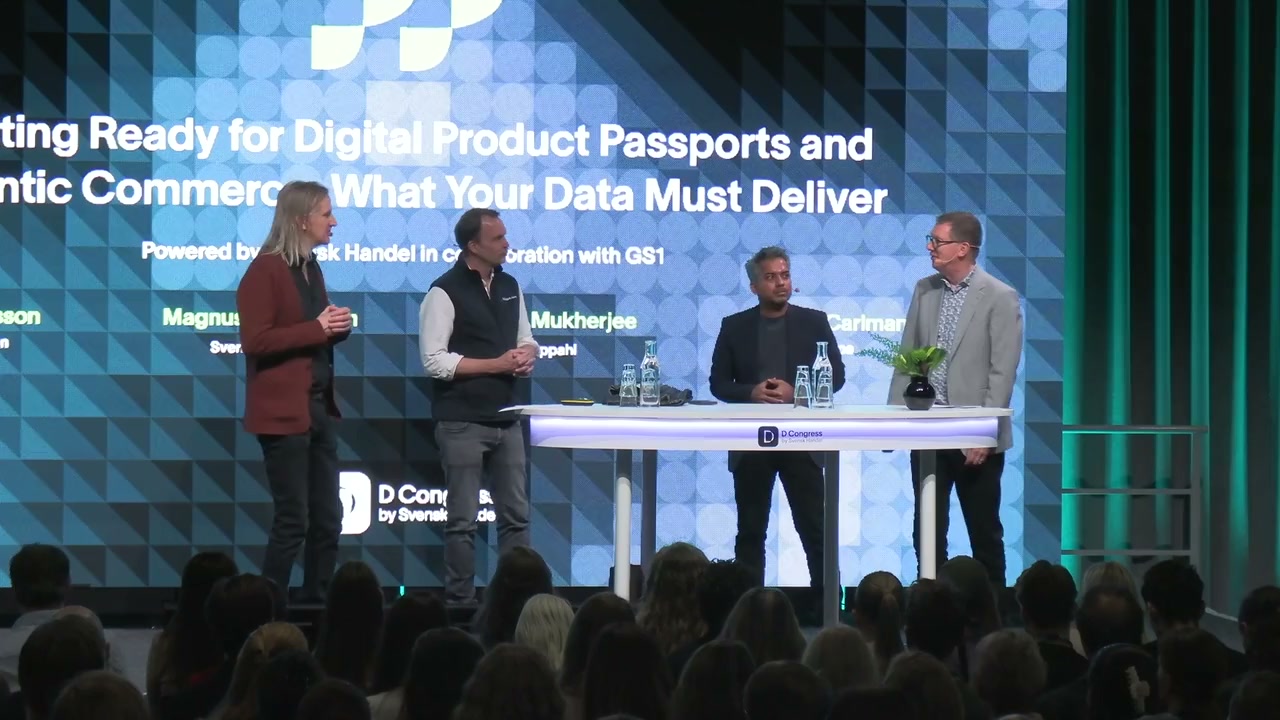
▶ Watch the full panel discussion on D-Congress — Stage F3: Retail Impact Arena. Featuring Magnus Nikkarinen (Svensk Handel), Staffan Olsson (GS1 Sweden), Partha Mukherjee (Kappahl Group), and Daniel Carlman (Blippa.com).
The Regulatory Push — But It’s Not Just About Compliance
The EU Green Deal is driving a wave of product data requirements. Digital Product Passports for textiles are expected by late 2027 or early 2028, with furniture following shortly after. But as the panel made clear: this isn’t just a compliance exercise.
“Transparency builds trust, and trust builds loyalty,” noted Partha from Kappahl Group. “So loyalty means more business.”
The ESPR (Ecodesign for Sustainable Products Regulation) is one piece. But the Circular Economy Act, paperless reporting initiatives, and product-specific regulations for batteries, toys, and detergents all point in the same direction: companies need to share more structured data about their products, digitally.
Agent Commerce: Product Data as Oxygen
Staffan Olsson from GS1 shared a powerful insight from a recent event in New York, where OpenAI and Google presented the Universal Commerce Protocol — a standard for AI agents to shop on behalf of consumers.
The message from OpenAI was clear: “Structured, clean data in product feeds is crucial. Product data becomes the oxygen for agent commerce.”
This means that companies investing in structured product data today aren’t just preparing for EU regulation — they’re preparing for the next generation of commerce, where AI agents discover, compare, and purchase products autonomously.
Already in Stores Today
At Blippa, we’ve been working with brands like Lindex, Eton Shirts and Nudie Jeans, to implement DPPs that are already live in retail stores. Each product carries a unique data asset — a digital identity that follows the product from manufacturing through sale, use, repair, and eventually recycling.
“Just two weeks ago, I picked up a pair of jeans in Stockholm with a live DPP,” Daniel shared during the panel. “This specific pair has a unique data set. With item level DPP your opportunities multiply. You can add repair logs, validate authenticity, and report back when it’s recycled.”
No Vendor Lock-in: Use Your Own Domain
One critical point the panel stressed: ESPR Article 10 explicitly prohibits vendor lock-in. Whatever DPP system you choose, you should use your own domain for the QR codes and digital links. This ensures you can switch providers without reprinting every label.
As Staffan explained: “We’ve seen early DPP providers say ‘we’ll put QR codes on all your products’ — but those codes lead to their platform. You can never get rid of them because your products are out there with their QR codes.”
Using GS1 Digital Link as the standard ensures interoperability and independence.
Start Small, Evolve Over Time
The panel’s consensus: you don’t need everything perfect from day one.
“Most companies have a vast majority of different data sources, and they need to start with the data they have,” Daniel explained. “If you have a CSV file or a Google Sheet, you can even start with that. Then evolve into ERP integration, Pim systems and add traceability systems, and scale over time.”
For a company like Kappahl Group with 30 million sales units annually, the math is compelling but manageable — start with high-value product categories and expand. Not everything needs to be item level.
The Bottom Line
Digital Product Passports are coming. The question isn’t if, but when and how. Companies that start now — even with imperfect data — will have a significant head start. And the benefits extend far beyond compliance:
- Reduced returns through better product information
- Brand loyalty through transparency and trust
- New revenue channels through agent commerce readiness
- Operational efficiency through structured data and automation
- Circular economy enablement through product lifecycle tracking
Ready to start your DPP journey? Blippa makes it easy to create Digital Product Passports — no code required. Start with the data you have, connect your systems via API, and evolve over time.